
The Micro-App Flood: How Many Music Learning Apps Now Launch, and Who Uses Them
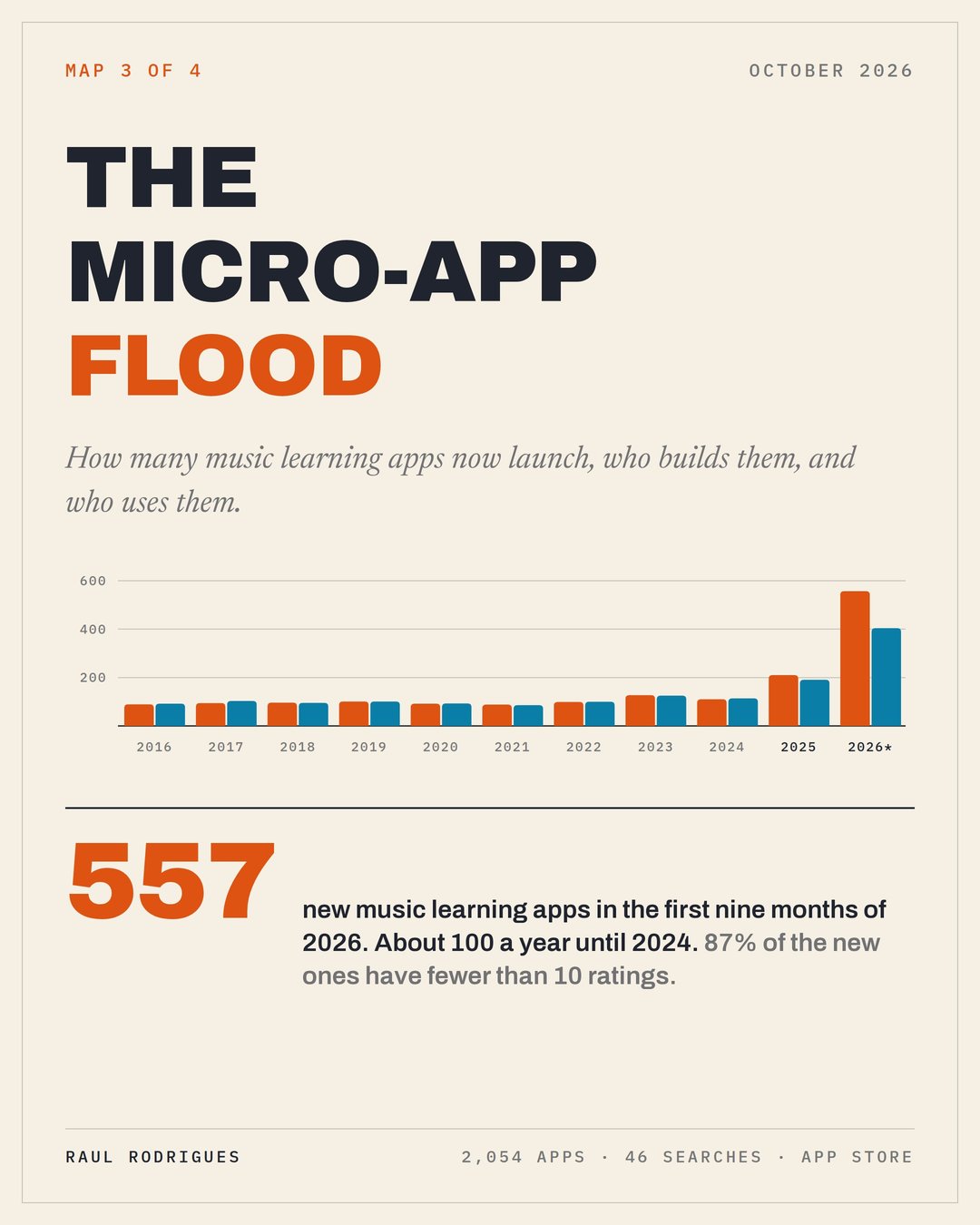
Map 3 of the online music learning industry. About 100 new music learning apps a year until 2024, 557 in the first nine months of 2026. 87% of the new ones have fewer than 10 ratings. The top of the store has not moved. By Raul Rodrigues.

The Micro-App Flood
Map 3 of 4. October 2026. By Raul Rodrigues, founder of Upbeat Studio.
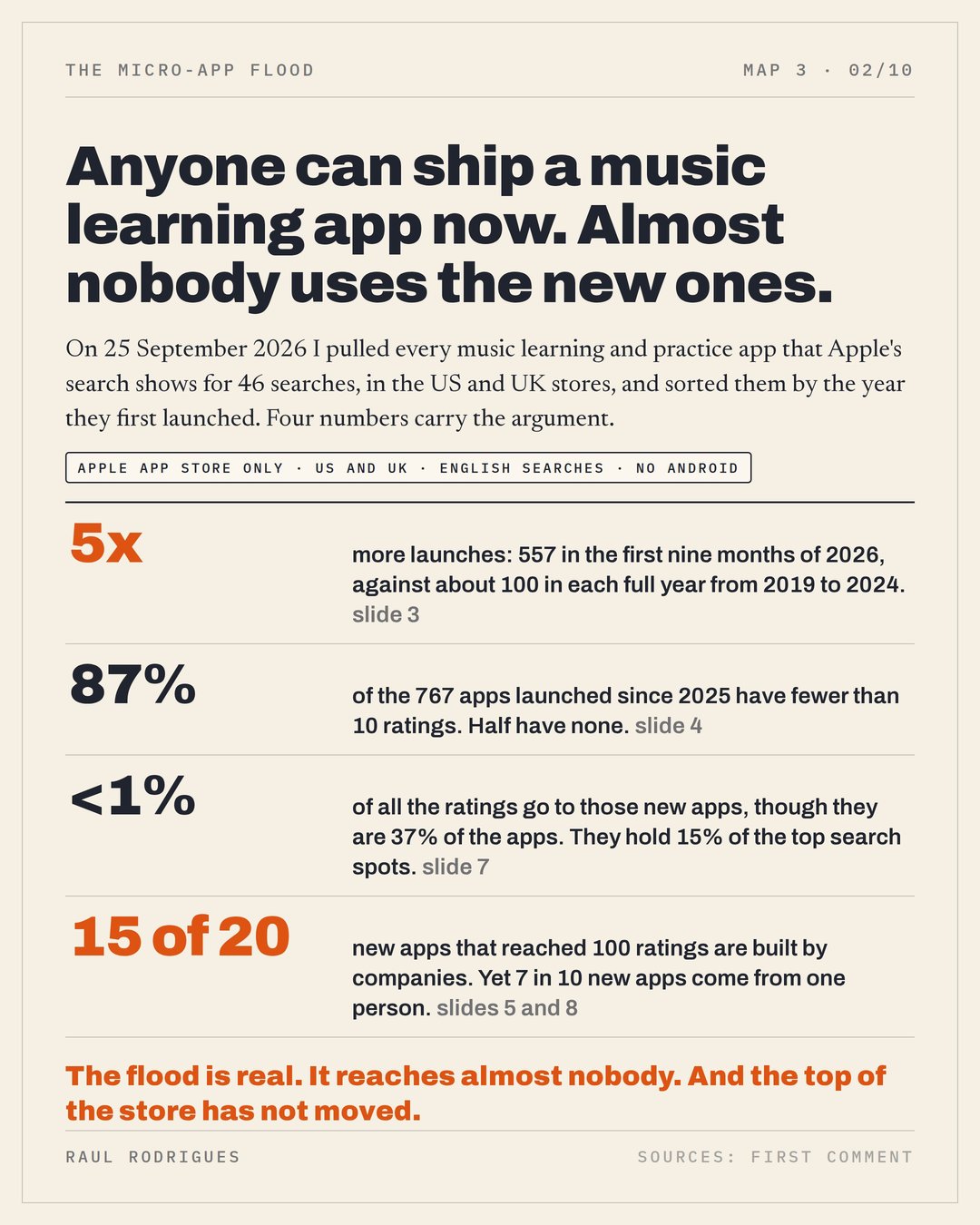
Anyone can build a music learning app now. So I counted them. On 25 September 2026 I pulled every music learning and practice app that Apple's search shows for 46 searches, in the US and UK stores, and sorted them by the year they first launched. The argument fits in one sentence: anyone can ship a music learning app now, and almost nobody uses the new ones. Four numbers carry it.
- 5x more launches: 557 in the first nine months of 2026, against about 100 in each full year from 2019 to 2024.
- 87% of the 767 apps launched since 2025 have fewer than 10 ratings. Half have none.
- Under 1% of all the ratings go to those new apps, though they are 37% of the apps. They hold 15% of the top search spots.
- 15 of 20 new apps that reached 100 ratings are built by companies. Yet 7 in 10 new apps come from one person.
Map 1 mapped who owns what in this industry. Map 2 was about what beginners are promised. This one is about the shelf they choose from. The rules are the same: public data only, the method written down so anyone can repeat it, limits stated, corrections welcome and credited.
For six years the line was flat. Then it broke.
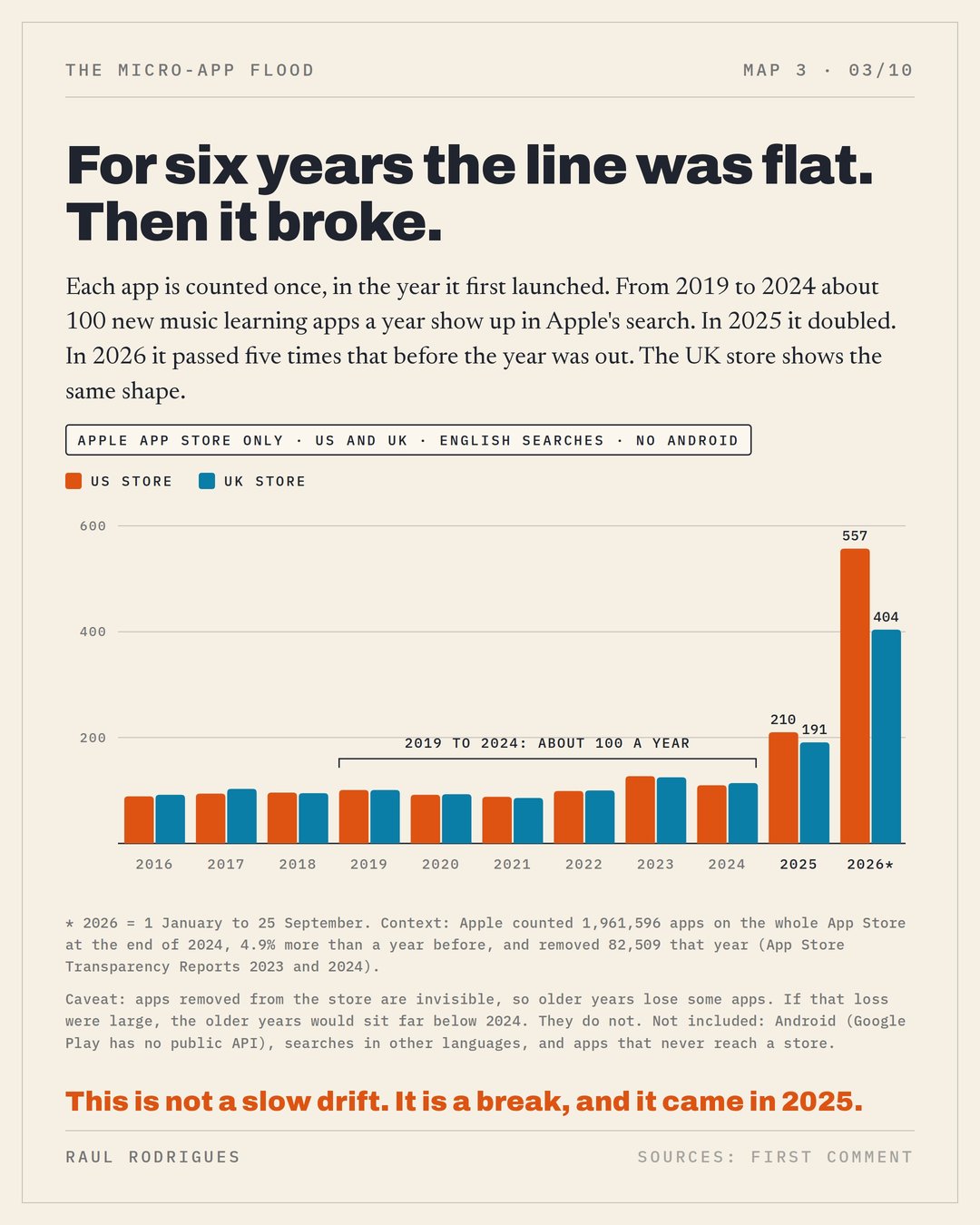
Each app is counted once, in the year it first launched. From 2019 to 2024 about 100 new music learning apps a year show up in Apple's search. In 2025 there were 210. In the first nine months of 2026 there were 557. The UK store shows the same shape: about 100 a year, then 191, then 404.
A fair objection: apps that were removed from the store cannot be seen, so older years always look smaller. Apple does remove apps. It removed 82,509 in 2024, and it removes apps that have not been updated in three years and are almost never downloaded. But if that loss were large, the older years would sit far below 2024, and they do not. The line is flat for six years and then it jumps. This is not a slow drift. It is a break, and it came in 2025.
Almost nobody comes
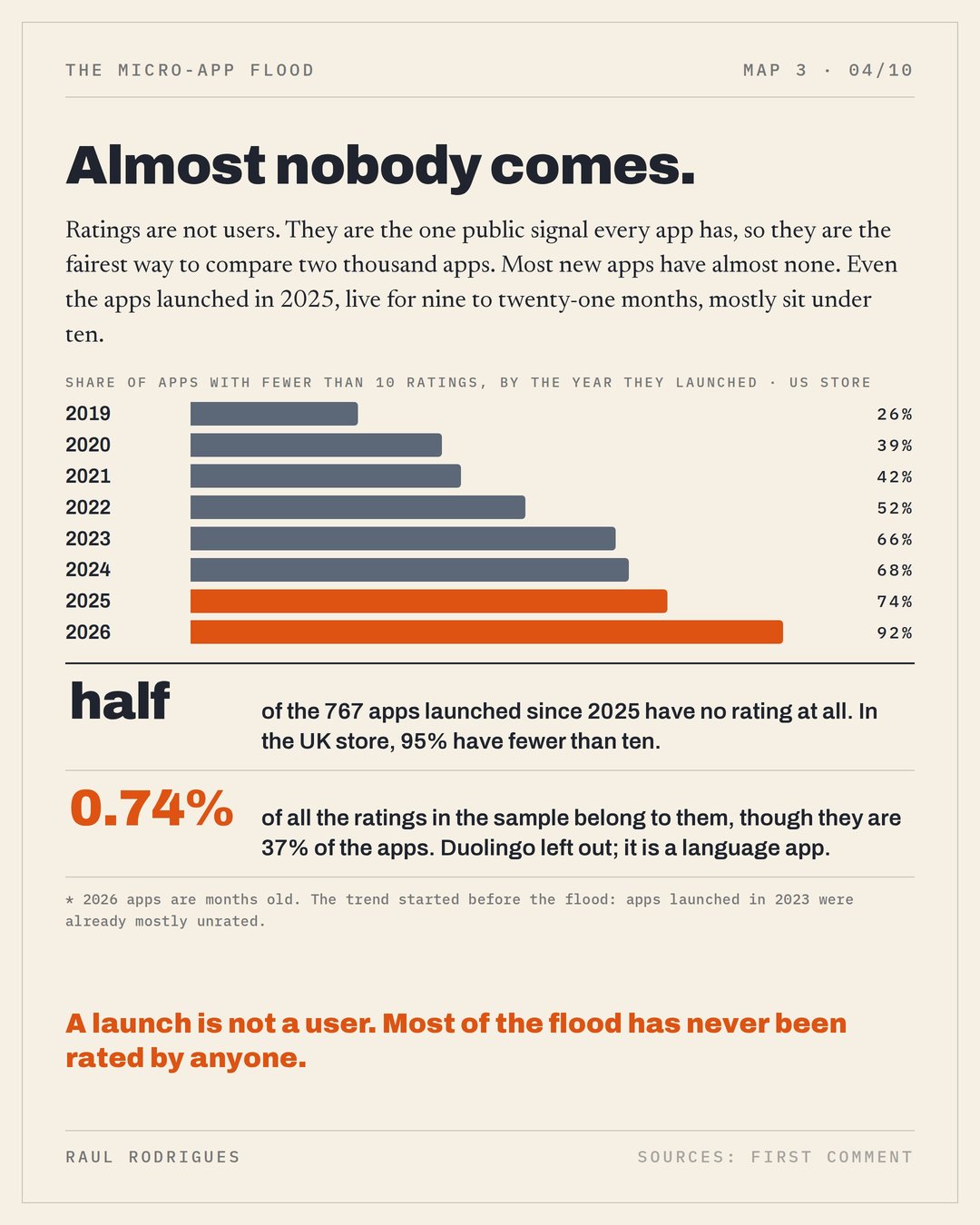
Ratings are not users. They are the one public signal every app has, so they are the fairest way to compare two thousand apps. Of the 767 apps launched since January 2025, 87% have fewer than 10 ratings in the US store and half have none. Even the apps launched in 2025, live for nine to twenty-one months, mostly sit under ten. Together the new apps are 37% of the apps in the sample and hold 0.74% of the ratings.
The trend started before the flood. Apps launched in 2023 were already mostly unrated. What changed in 2025 is how many there are.
Seven in ten new apps come from one person. That is not new.
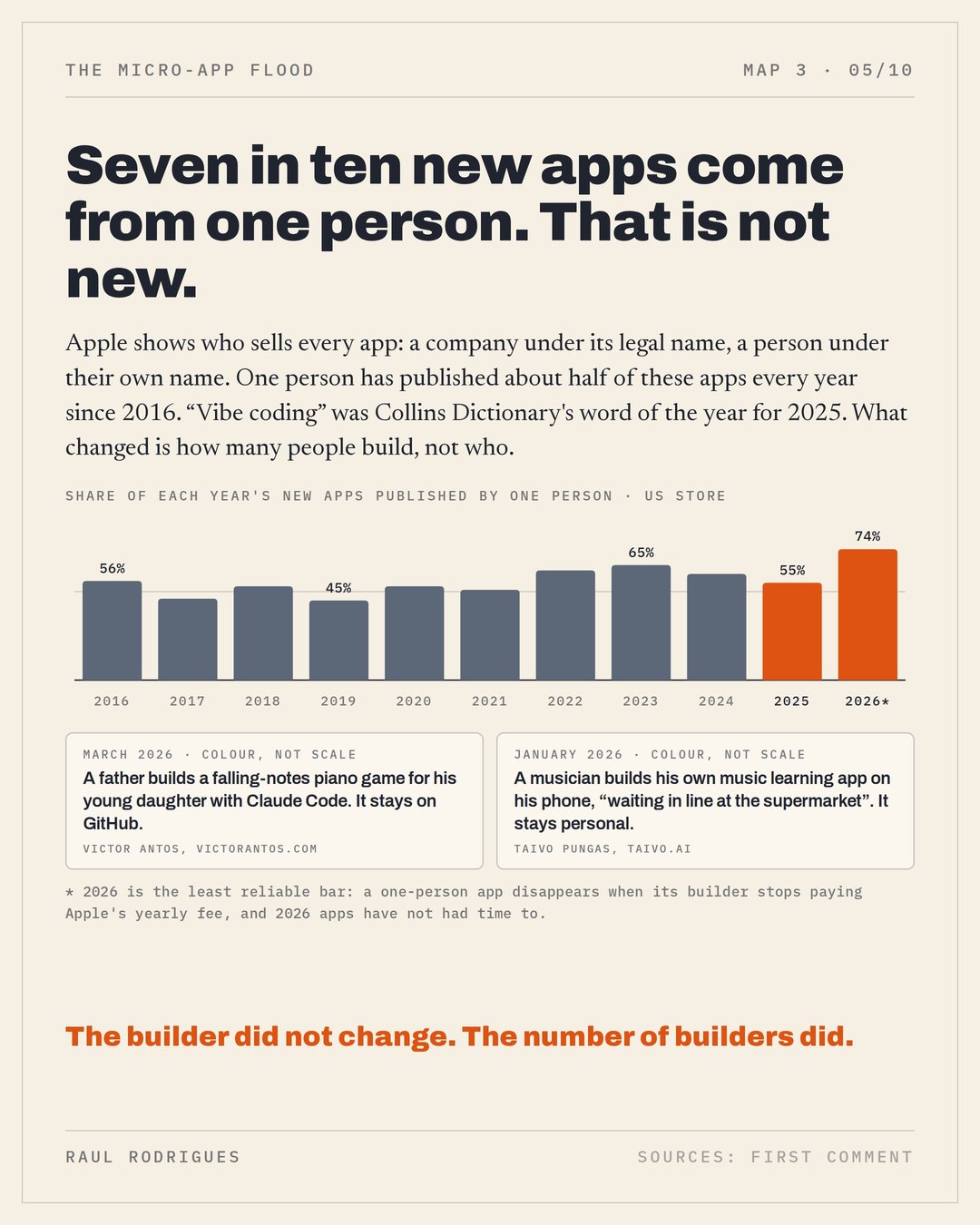
Apple shows who sells every app: a company under its legal name, or a person under their own name. Since 2025, 69% of new music learning apps are sold by one person. But one person has published about half of these apps every year since 2016, from 45% to 65%. "Vibe coding", building software by describing it to an AI, was Collins Dictionary's word of the year for 2025. The builder did not change. The number of builders did.
Two stories give the colour, not the scale. In March 2026 a father built a falling-notes piano game for his young daughter with Claude Code and put it on GitHub. In January 2026 a musician built his own music learning app on his phone, partly "waiting in line at the supermarket". Neither reached the App Store. The flood the store shows is only the part that ships.
Most new apps solve one small problem
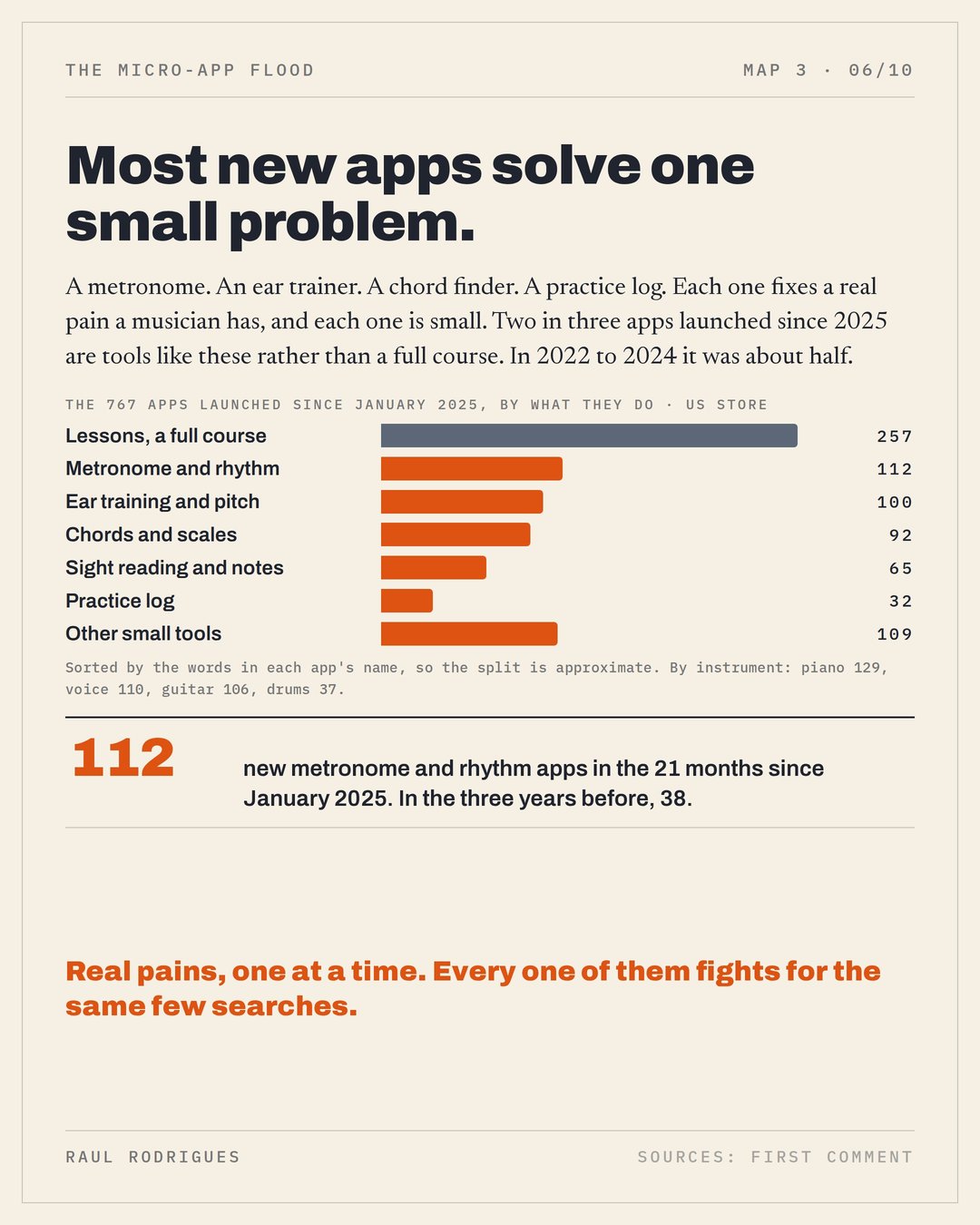
A metronome. An ear trainer. A chord finder. A practice log. Each one fixes a real pain a musician has, and each one is small. Two in three apps launched since 2025 are single-purpose tools rather than a full course; in 2022 to 2024 it was about half. There were 112 new metronome and rhythm apps in the 21 months since January 2025, against 38 in the three years before. By instrument, piano leads with 129 new apps, then voice 110, guitar 106 and drums 37. Every one of them fights for the same few searches.
The top of the store has not moved
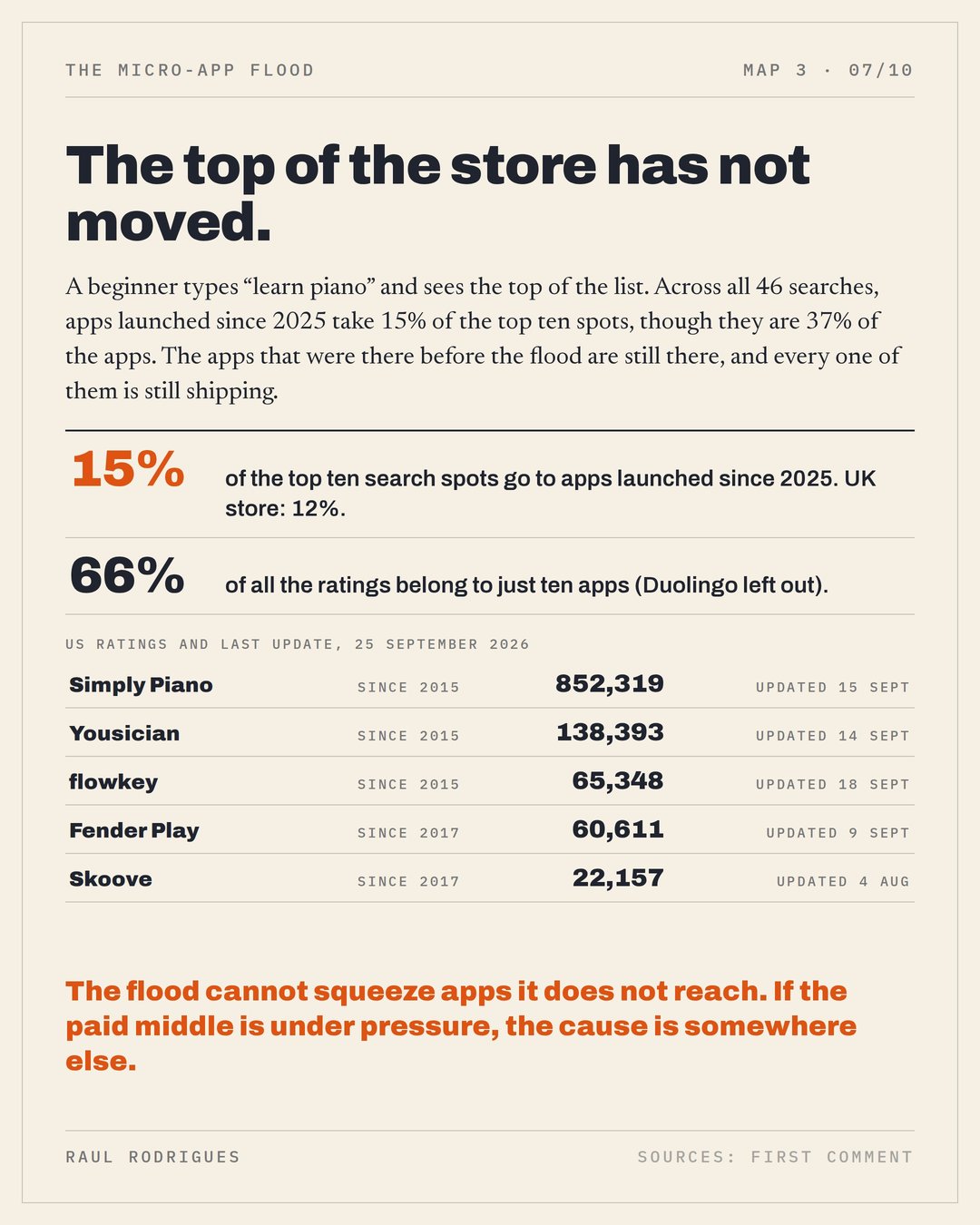
A beginner types "learn piano" and sees the top of the list. Across all 46 searches, apps launched since 2025 take 15% of the top ten spots, though they are 37% of the apps. The ten most-rated apps hold 66% of all the ratings. The apps that were there before the flood are still there, and every one of them shipped an update in the last eight weeks: Simply Piano, Yousician, flowkey, Fender Play, Skoove.
There is a story this industry tells about itself: a free giant above, a flood of cheap apps below, and the paid middle squeezed in between. The data says the lower half of that story is wrong. The flood cannot squeeze apps it does not reach. If the paid middle is under pressure, the cause is somewhere else.
The few that break through have one job and a team
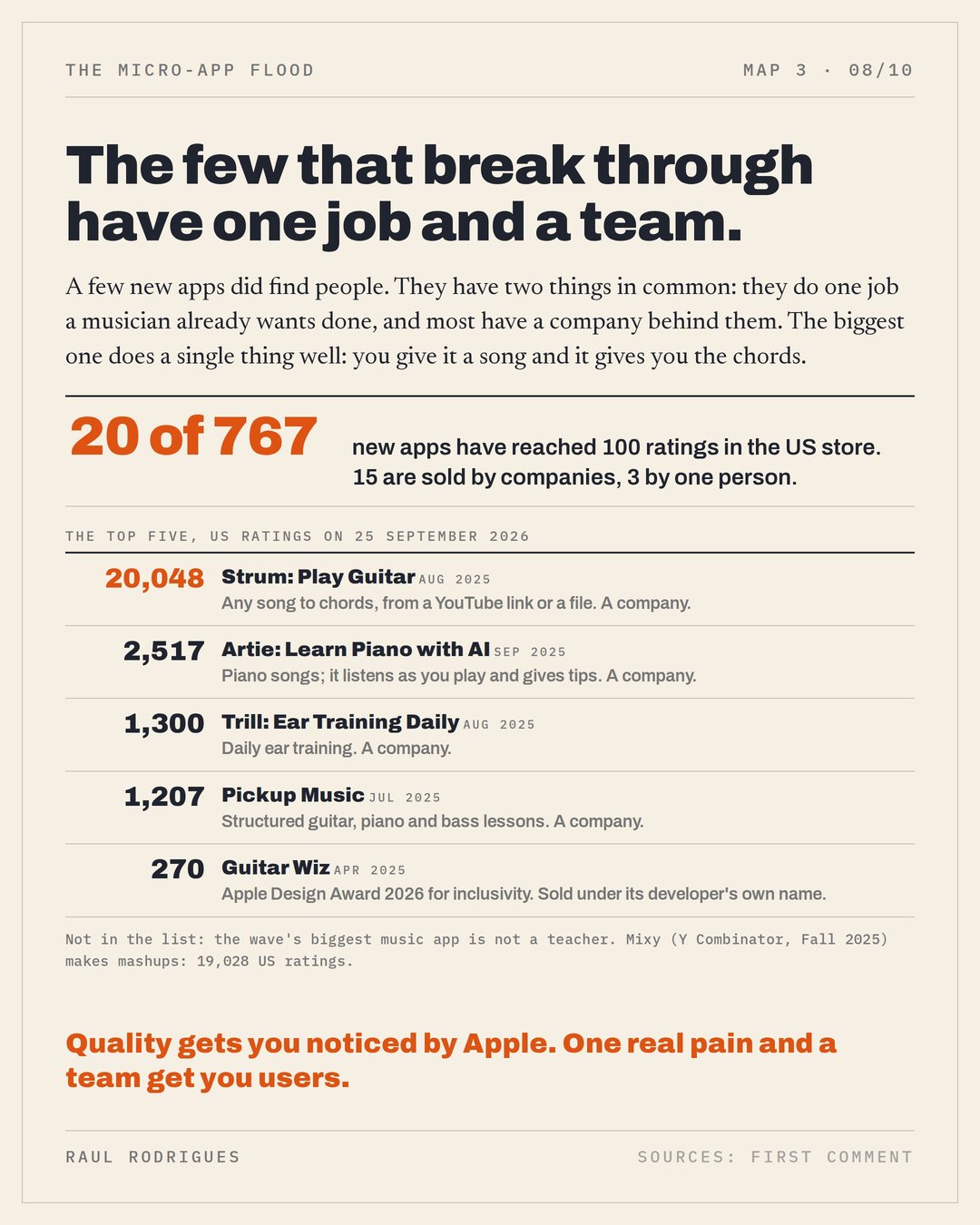
A few new apps did find people. Only 20 of the 767 have reached 100 ratings in the US store, and 15 of those are sold by companies. The biggest one, Strum, does a single thing well: you give it a song and it gives you the chords. It has 20,048 US ratings in thirteen months. Next come Artie (piano songs with feedback as you play), Trill (daily ear training) and Pickup Music (structured guitar, piano and bass lessons).
Guitar Wiz won Apple's 2026 Design Award for inclusivity. It has 270 US ratings. Quality gets you noticed by Apple. One real pain and a team get you users. And the wave's biggest music app is not a teacher at all: Mixy, from Y Combinator's Fall 2025 batch, makes mashups.
More apps. Same first year.
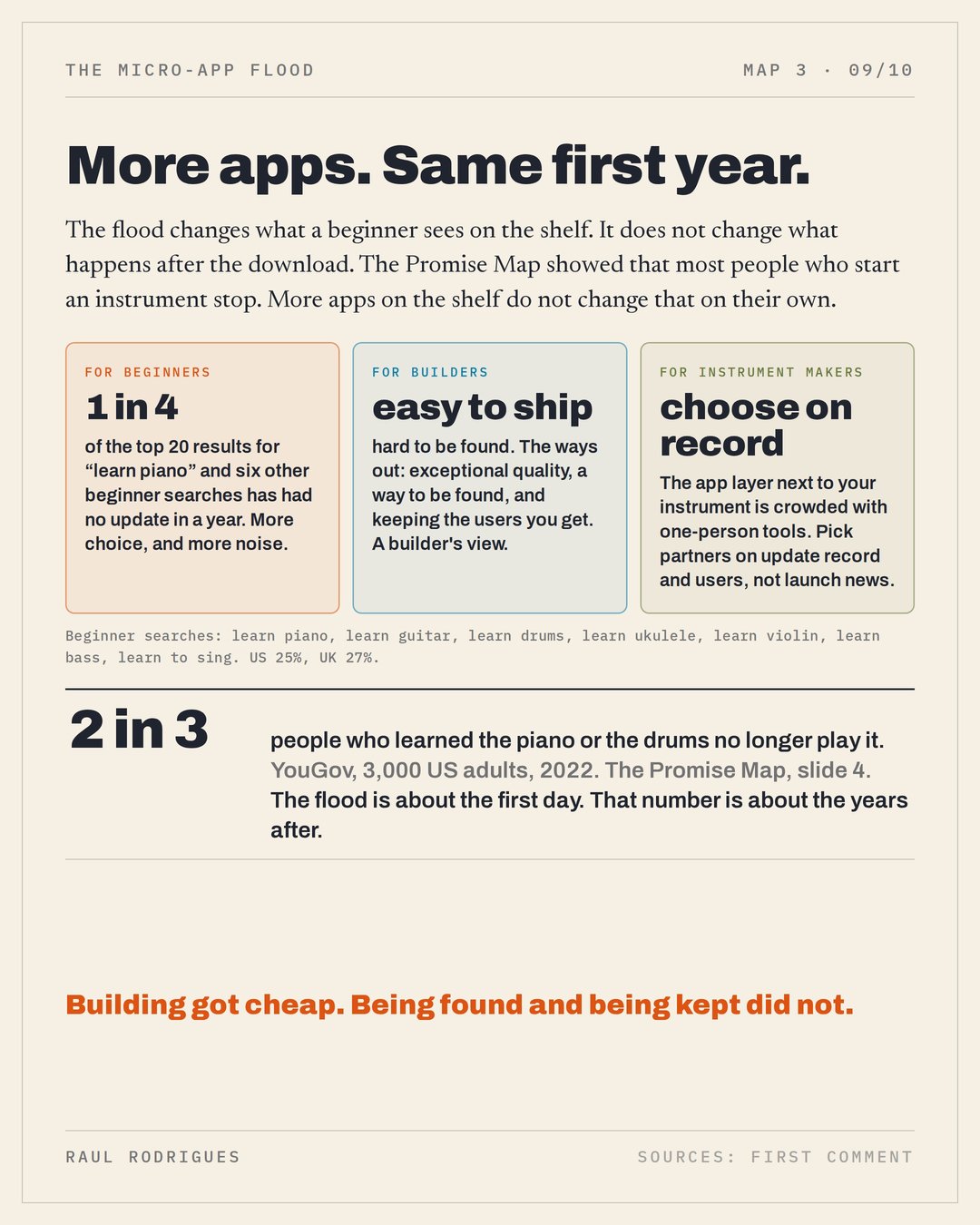
The flood changes what a beginner sees on the shelf. It does not change what happens after the download. For seven beginner searches, from "learn piano" to "learn to sing", one in four of the top 20 results has had no update in a year. More choice, and more noise.
For builders, and I am one, a small tool is easy to ship and hard to be found. The ways out I see are exceptional quality, a way to be found, and keeping the users you get. That is a builder's view, not a finding. For instrument makers, the app layer next to your instrument is crowded with one-person tools, and the ones that last are not the new ones. Pick partners on update record and users, not launch news.
And the number from Map 2 has not gone anywhere: two in three people who learned the piano or the drums no longer play it. The flood is about the first day. That number is about the years after.
Three things this map says
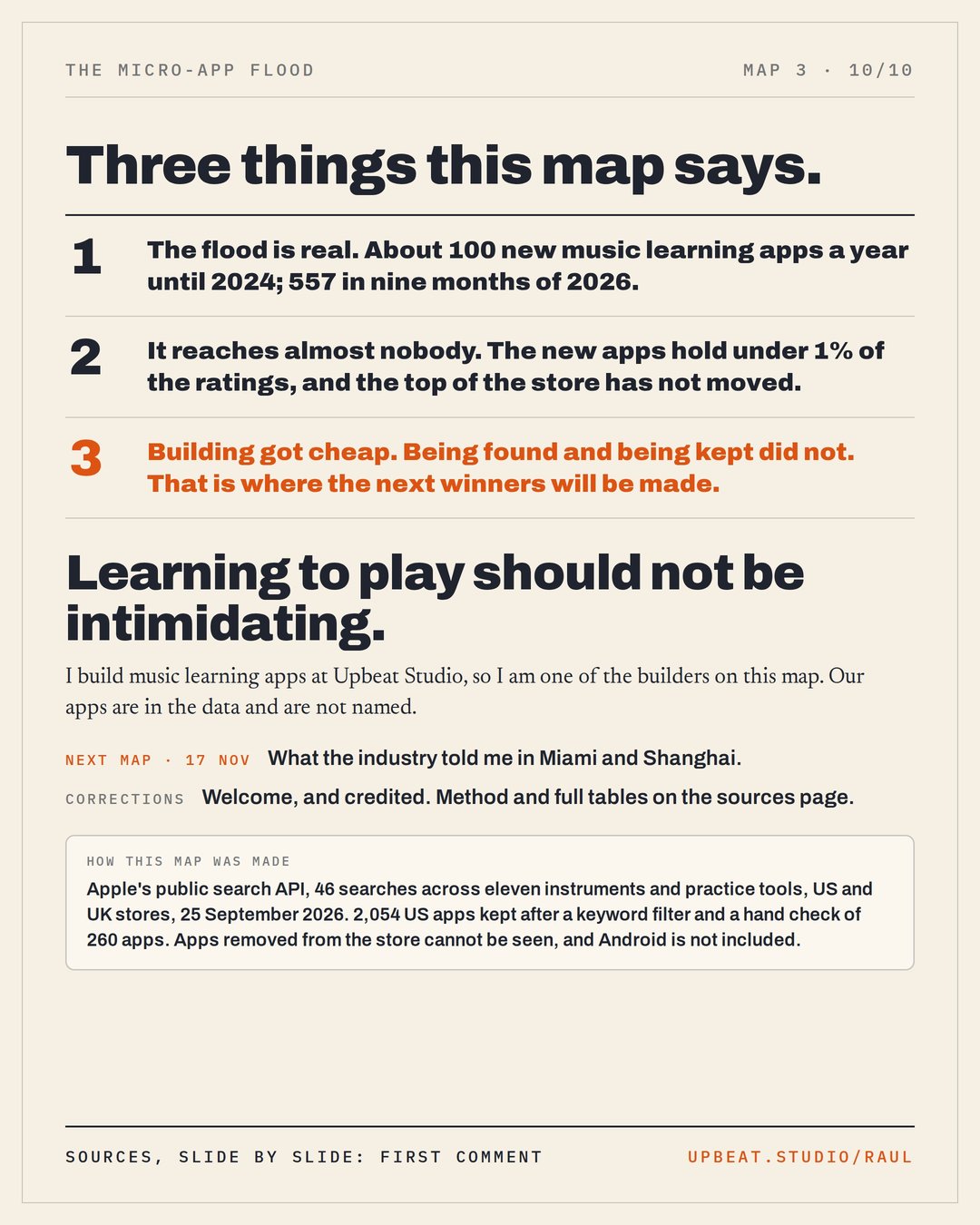
- The flood is real. About 100 new music learning apps a year until 2024; 557 in nine months of 2026.
- It reaches almost nobody. The new apps hold under 1% of the ratings, and the top of the store has not moved.
- Building got cheap. Being found and being kept did not. That is where the next winners will be made.
Learning to play should not be intimidating. I build music learning apps at Upbeat Studio, so I am one of the builders on this map; our apps are in the data and are not named. Next map, on 17 November: what the industry told me in Miami and Shanghai.
Download the map: The Micro-App Flood, PDF, 10 pages.
How this map was made
- Source: Apple's public iTunes Search API, which needs no key and anyone can repeat. Apple documentation.
- 46 searches on 25 September 2026, in the US and UK stores, up to 200 results each: eleven instruments (piano and keyboard, guitar, drums, voice, bass, ukulele, violin, cello, saxophone, flute, trumpet) and practice tools (metronome, ear training, sight reading, rhythm, chords, music theory, scales, intervals, practice journals, perfect pitch, solfège).
- Scope, said plainly: Apple's App Store only, US and UK stores, searches in English. Google Play is not included (it has no public API), nor are apps in other languages or tools that never reach a store. The flood could be larger or smaller there; this map cannot say.
- Each app is counted once, by Apple's app id, in the year it first launched.
- Kept: music learning and practice apps, by a keyword and category filter. Left out: games without a learning word in the name, instrument simulators, karaoke and social singing apps, players, DJ and remix tools, tuners on their own, and apps that are not about music (children's reading, accent training, fitness). Every exclusion is logged with its reason.
- Checked by hand: two blind samples of 100 apps each (half from 2022 to 2024, half from 2025 to 2026) and the 60 most-rated apps. After the fixes, 96% to 100% of kept apps are correct; the few errors sit mostly in older years, which makes the jump look smaller, not bigger.
- Result: 2,054 apps in the US store and 1,916 in the UK store.
- One person or a company: Apple's seller of record, sorted by legal-form words and name patterns; 79 of 80 sampled "one person" sellers are people.
- What it cannot see: apps removed from the store; Android, because Google Play has no public API; anything Apple's search does not rank for these 46 searches. This is a large sample, not a census, and ratings are a weak proxy for use.
Sources, slide by slide
Slide 3: the flood
| Year | US store | UK store |
|---|---|---|
| 2016 | 89 | 92 |
| 2017 | 94 | 103 |
| 2018 | 96 | 95 |
| 2019 | 101 | 101 |
| 2020 | 92 | 93 |
| 2021 | 88 | 86 |
| 2022 | 99 | 100 |
| 2023 | 127 | 125 |
| 2024 | 110 | 114 |
| 2025 | 210 | 191 |
| 2026 (1 Jan to 25 Sep) | 557 | 404 |
- "5x": 557 in 2026 so far against an average of 103 a year from 2019 to 2024, US store. No projection of the rest of 2026.
- 1,870,119 apps on the App Store at the end of 2023 and 1,961,596 at the end of 2024; 82,509 apps removed in 2024. Apple, App Store Transparency Report 2023 and 2024.
- Removal of outdated apps: App Store Improvements, Apple Developer and Apple Developer News, 2022.
Slide 4: nobody comes
- Share of apps with fewer than 10 US ratings, by launch year: 2019 26%, 2020 39%, 2021 42%, 2022 52%, 2023 66%, 2024 68%, 2025 74%, 2026 92%.
- Since 1 January 2025: 767 apps in the US store, 87% under 10 ratings, 51% with none. UK store: 595 apps, 95% under 10 ratings.
- They are 37% of the US sample and hold 0.74% of its ratings. Duolingo is left out of the ratings shares: it is a language app, and its 5.5 million US ratings are not music ratings.
Slide 5: who builds
- Share of each year's new apps sold under one person's own name, US store: 2016 56%, 2017 46%, 2018 53%, 2019 45%, 2020 53%, 2021 51%, 2022 62%, 2023 65%, 2024 60%, 2025 55%, 2026 74%. Since 2025: 69%. The 2026 figure is the least reliable: an app disappears when its developer stops paying Apple's yearly membership, and 2026 apps have not had time to.
- "Vibe coding", Collins Dictionary's word of the year 2025. Collins, November 2025.
- Victor Antos, "Hold My Beer: I Vibe-Coded a Piano Game for My Daughter", 22 March 2026, Claude Code, open-sourced as PianoFun. victorantos.com and GitHub.
- Taivo Pungas, "Vibe coding a music learning app", 4 January 2026, Claude Code and Codex. taivo.ai.
Slide 6: what they build
- The 767 US apps launched since January 2025, sorted by the words in each app's name: full courses and lessons 257; metronome and rhythm 112; ear training and pitch 100; chords and scales 92; sight reading and notes 65; practice logs 32; other small tools 109. Approximate by design.
- Single-purpose tools: 66% since 2025, 54% in 2022 to 2024. Metronome and rhythm: 112 since January 2025, 38 in 2022 to 2024.
- By instrument since 2025: piano 129, voice 110, guitar 106, drums 37.
Slide 7: the shelf
- Top 10 results of all 46 searches, raw and unfiltered: 15% of spots held by apps launched since 2025 (UK 12%).
- The 10 most-rated apps hold 66% of all ratings in the US sample, Duolingo left out.
- US ratings and last update on 25 September 2026: Simply Piano 852,319 (updated 15 Sept); Yousician 138,393 (14 Sept); flowkey 65,348 (18 Sept); Fender Play 60,611 (9 Sept); Skoove 22,157 (4 Aug).
Slide 8: the exceptions
- 20 of 767 new apps have reached 100 US ratings: 15 sold by companies, 3 by one person, 2 unclear.
- Strum: Play Guitar, W185 Holdings LLC, 6 August 2025, 20,048 US ratings. App Store.
- Artie: Learn Piano with AI, Art Master Academy s.r.o., 15 September 2025, 2,517. App Store.
- Trill: Ear Training Daily, gmol6.studio s.r.o., 27 August 2025, 1,300. App Store.
- Pickup Music: Music Lessons, Pickup Music Inc., 2 July 2025, 1,207. App Store.
- Guitar Wiz, 22 April 2025, 270; 2026 Apple Design Award for Inclusivity. Apple Newsroom, June 2026 and App Store.
- Mixy: Make Mashups, Mixy, Inc., 19 June 2025, 19,028 US ratings; "1.5 million users" is the company's own claim. Y Combinator and App Store.
Slide 9: what it means
- Seven beginner searches (learn piano, learn guitar, learn drums, learn ukulele, learn violin, learn bass, learn to sing): 25% of the top 20 results in the US store have had no update in 12 months (UK 27%); 17% have fewer than 10 ratings (UK 26%).
- "2 in 3": YouGov, "Musical Instrument Experiences", 3,000 US adults, 2022: 66% of those who learned piano and 63% of those who learned drums no longer play. Toplines PDF.
What this map does not claim
- It does not measure downloads, revenue or active users.
- It does not say AI coding tools caused the flood. The timing matches; the data cannot show cause.
- It does not say new apps are worse. Some are excellent; the award winner on slide 8 is one.
Corrections log
Empty at publication. If you find a figure that is wrong, outdated or missing its context, message me on LinkedIn. Verified corrections are folded into the map and credited here.
About the author
I am Raul Rodrigues, a drummer, a former music-school founder and the founder of Upbeat Studio in Valencia, where we build Drum Coach and Drum Notes. I map the music learning industry because nobody else publishes it, and because the thing I care about most, keeping beginners playing through their first year, is the thing this industry measures least. Find me on LinkedIn.
YOU MIGHT ALSO LIKE

The Promise Map: What Music Learning Apps Promise Beginners, and What the Data Says Happens
Map 2 of the online music learning industry. Eight of twenty platforms name a time to your first song. Two in three people who learned an instrument no longer play. Nobody publishes what happens in between. By Raul Rodrigues.

The Online Music Learning Landscape: The First Public Map of the Industry
Map 1 of the online music learning industry. More than 45 platforms. Who owns them, how they make money, who walked away. Every figure with its source. By Raul Rodrigues.
How Atlanta Makes Drummers
Atlanta produces a remarkable number of working drummers. Not by accident: the city has an unusual concentration of institutions that teach rhythm to children and keep teaching it into adulthood.