
The Promise Map: What Music Learning Apps Promise Beginners, and What Actually Happens
Map 2 of the online music learning industry. Twenty platforms quoted word for word, seven datasets on who quits, and the one number nobody publishes. By Raul Rodrigues.

The Promise Map
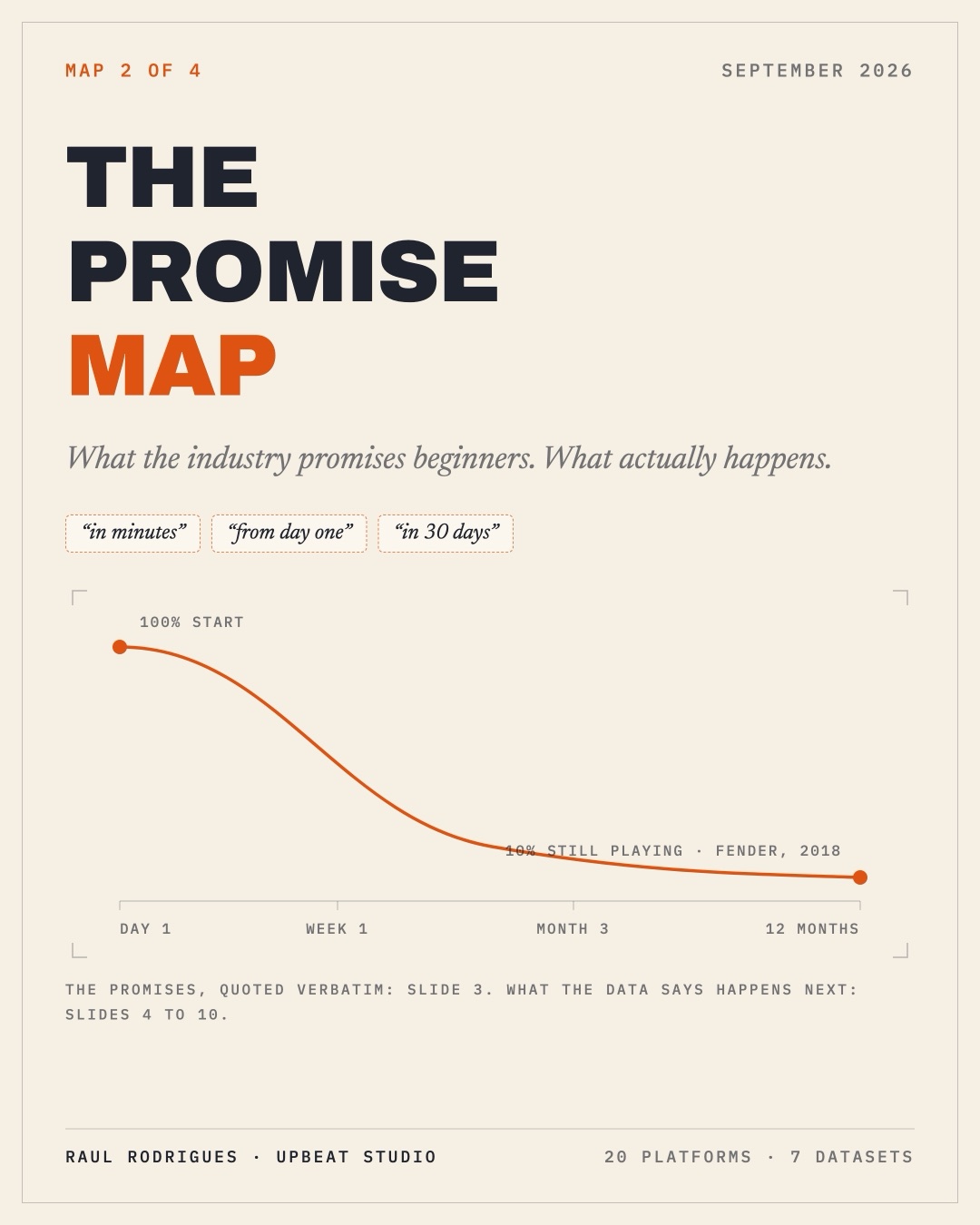
Map 2 of 4. September 2026. By Raul Rodrigues, founder of Upbeat Studio.
Every beginner is sold a timeline. In minutes. From day one. In 30 days. Two weeks ago I published the first public map of the online music learning industry: who owns what, how the money is made, who walked away. This second map asks a simpler question. What does the industry promise the people it sells to, and what actually happens to them?
I collected the promises 20 platforms make on their own pages and store listings, word for word, on 16 September 2026. Then I went looking for the data on who keeps playing. This page holds the twelve slides, the text behind them, and every source with its year. The PDF is at the bottom.
How to read this map
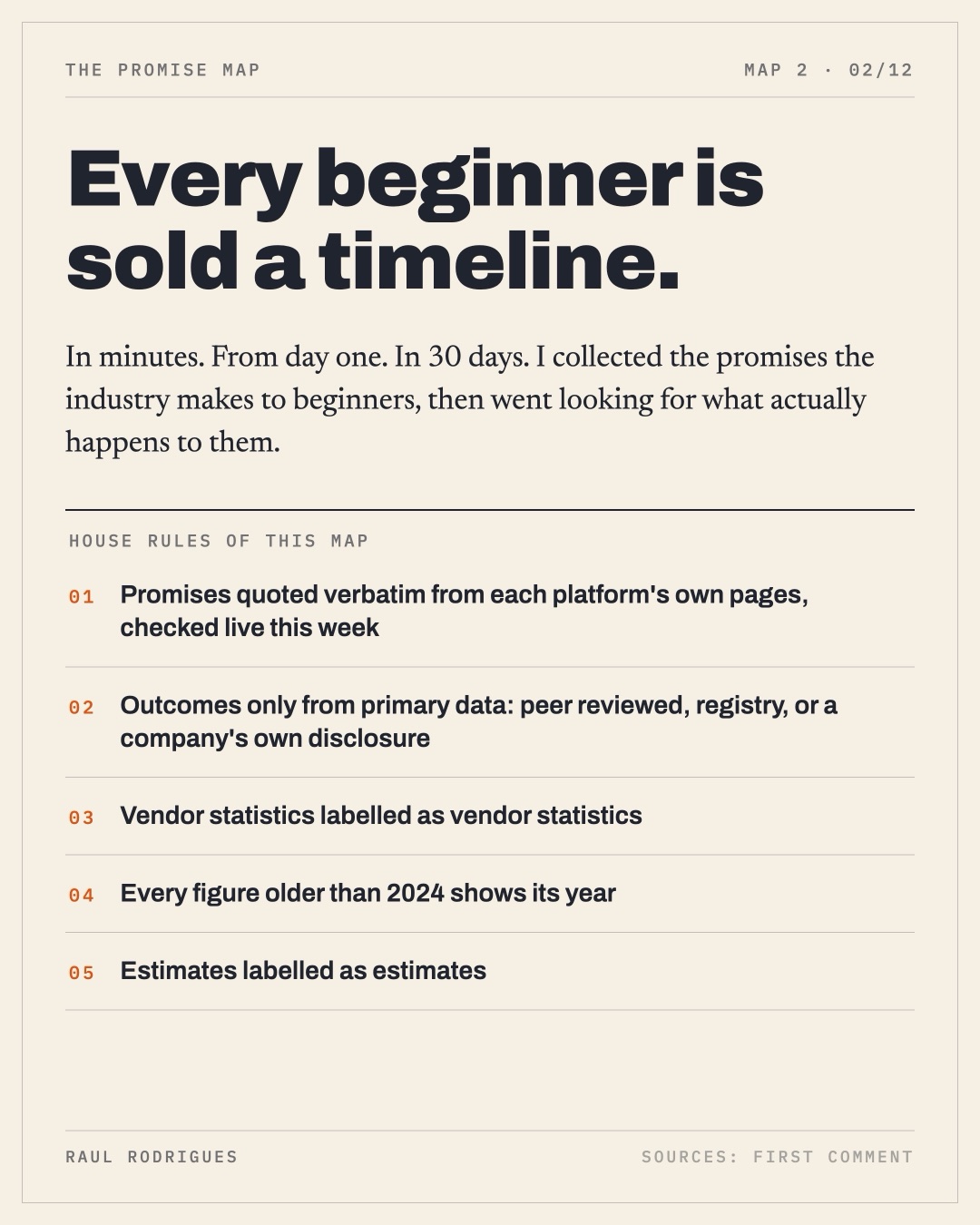
- Promises are quoted verbatim from each platform's own website or App Store listing, checked live the week of publishing.
- Outcomes come only from primary data: peer-reviewed studies, statutory filings, or a company's own disclosure.
- Vendor statistics are labelled as vendor statistics.
- Every figure older than 2024 shows its year on the slide.
- Estimates are labelled as estimates. Corrections are welcome and credited, and they go in the log at the end of this page.
1. Every beginner is sold a timeline
Nobody sells an instrument by saying it takes a year to sound like yourself. So the industry compresses time. My question was not whether the promises are true. It was whether anyone measures what happens after them.
2. What they promise
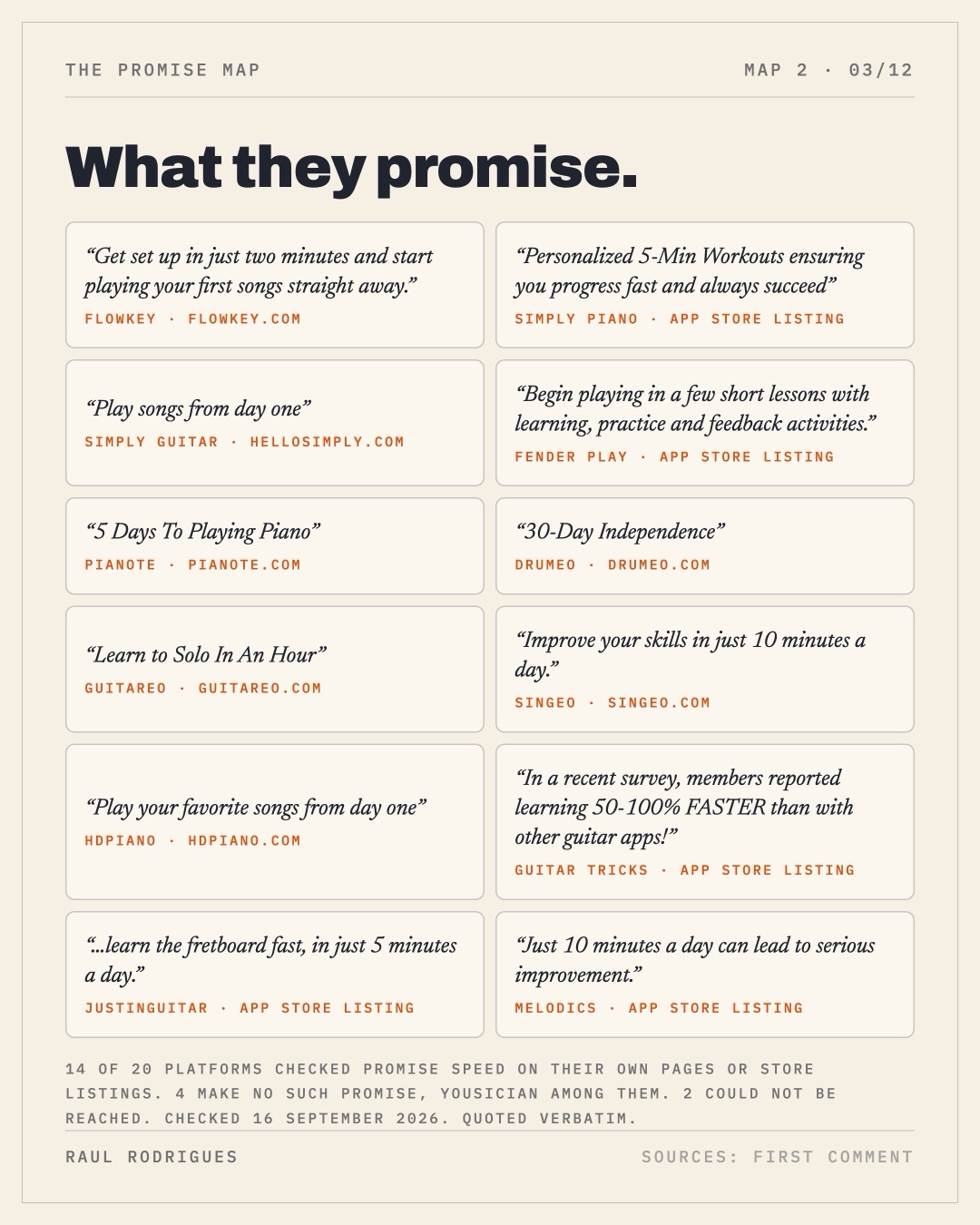
Fourteen of the twenty platforms I checked carry a speed or effort promise on their own website or store listing. "Get set up in just two minutes and start playing your first songs straight away." "5 Days To Playing Piano." "30-Day Independence." "Play songs from day one."
Four carry no such promise at all: Skoove, Synthesia, Duolingo Music and Yousician, which is the biggest earner in the category by its own statutory accounts. Two could not be reached. Where a website blocked automated reading, I used the platform's own App Store description, and the slide says so.
3. The number the whole industry runs on
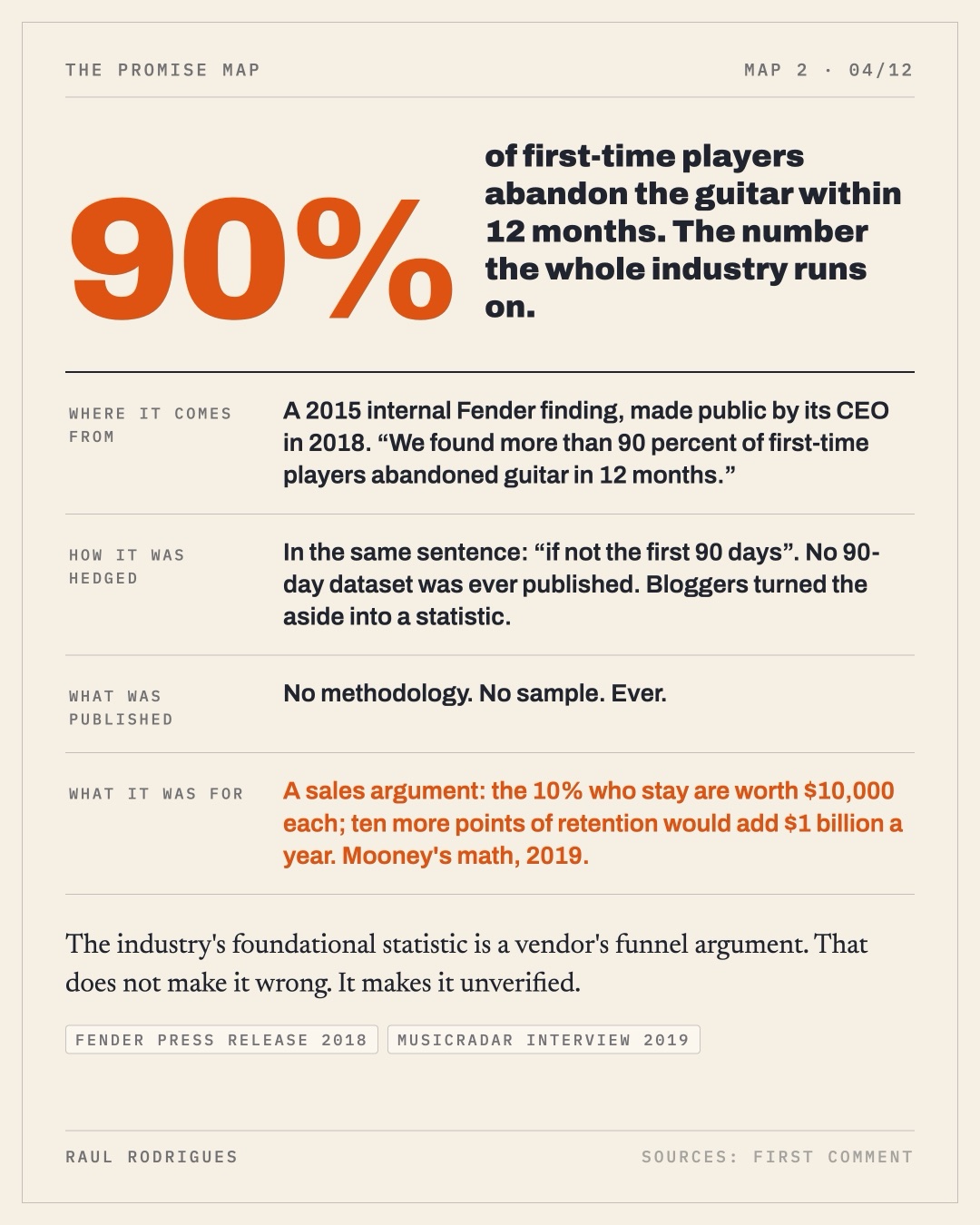
"90 percent of beginners quit in the first year." You have read it in every pitch deck, every retail blog and every app landing page. Here is where it comes from: a 2015 internal Fender finding, made public by its CEO in a 2018 press release. In the same sentence he hedged it: "in 12 months, if not the first 90 days". No 90-day dataset was ever published. Bloggers turned the aside into a statistic.
No methodology or sample has ever been released. And the number had a job: the ten percent who stay are worth about 10,000 dollars each, and ten more points of retention would add a billion dollars a year. That is the CEO's own math from 2019.
The industry's foundational statistic is a vendor's funnel argument. That does not make it wrong. It makes it unverified.
4. What independent data says
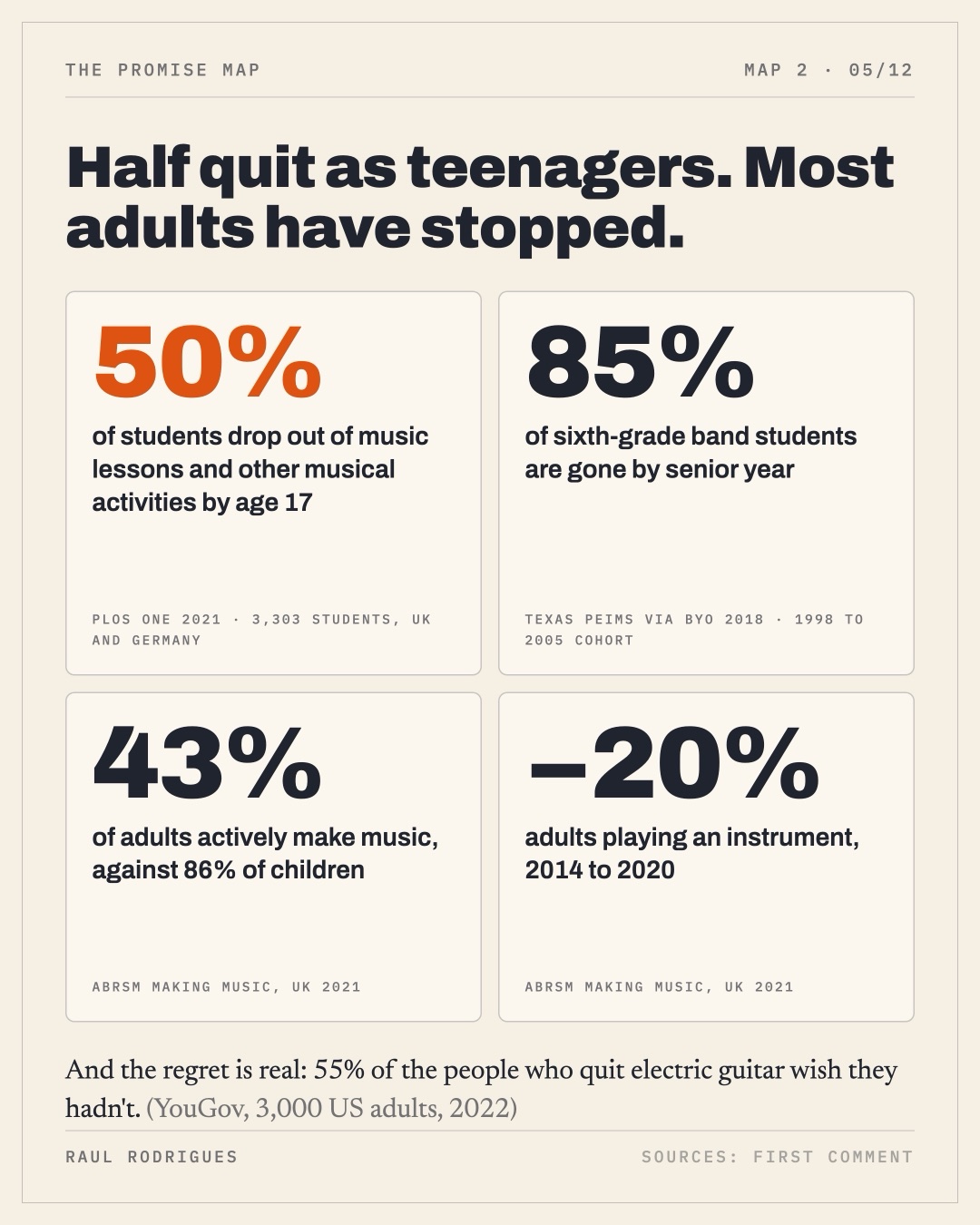
About 50 percent of students drop out of music lessons and other musical activities by age 17, most of them between 15 and 17. That is a peer-reviewed survival analysis of 3,303 students in the UK and Germany, published in PLOS One in 2021.
In Texas, 98,833 sixth-grade band students dwindled to 14,293 seniors, an 85 percent dropout rate. That cohort ran from 1998 to 2005, so read it as history, not as today.
Among adults the picture is bleaker. In the UK, 86 percent of children but only 43 percent of adults actively make music, and adult instrument playing fell 20 percent between 2014 and 2020. And the regret is real: 55 percent of people who quit electric guitar wish they had not.
5. The loudest retention bet never reported its result
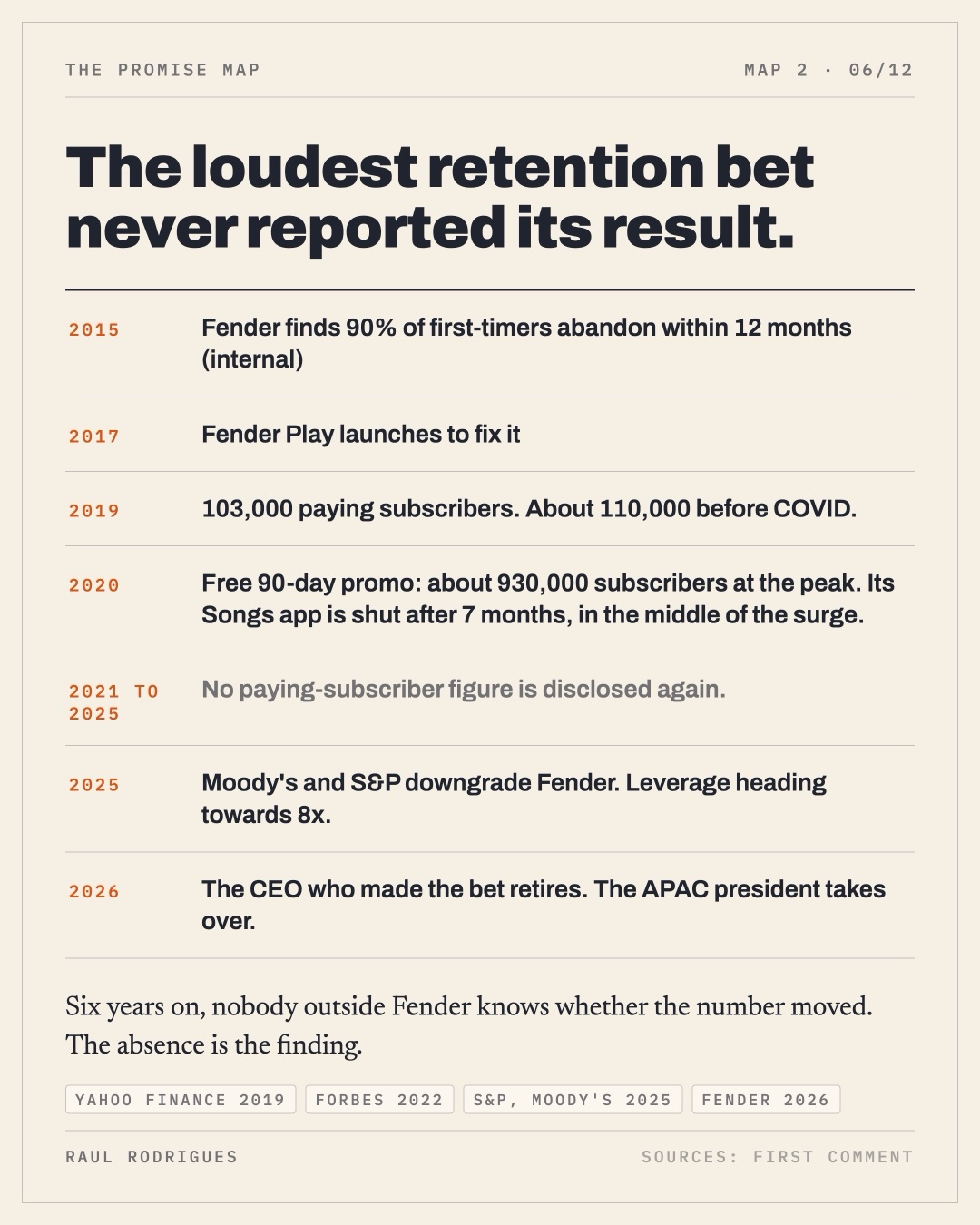
Fender made the 90 percent famous and built Fender Play in 2017 to fix it. In 2019 it had 103,000 paying subscribers, about 110,000 before COVID. In 2020 a free 90-day promotion took the subscriber count to about 930,000 at its peak. That same summer, in the middle of the biggest beginner surge in a generation, Fender shut its Songs app after seven months.
From 2021 to today, no paying-subscriber figure has been disclosed again. In March 2025 both rating agencies downgraded the company, with leverage heading towards eight times earnings. In February 2026 the CEO who made the bet retired and the president of the Asia Pacific business took over.
Six years on, nobody outside Fender knows whether the retention number moved. The absence is the finding.
6. The subscription model monetizes January intentions
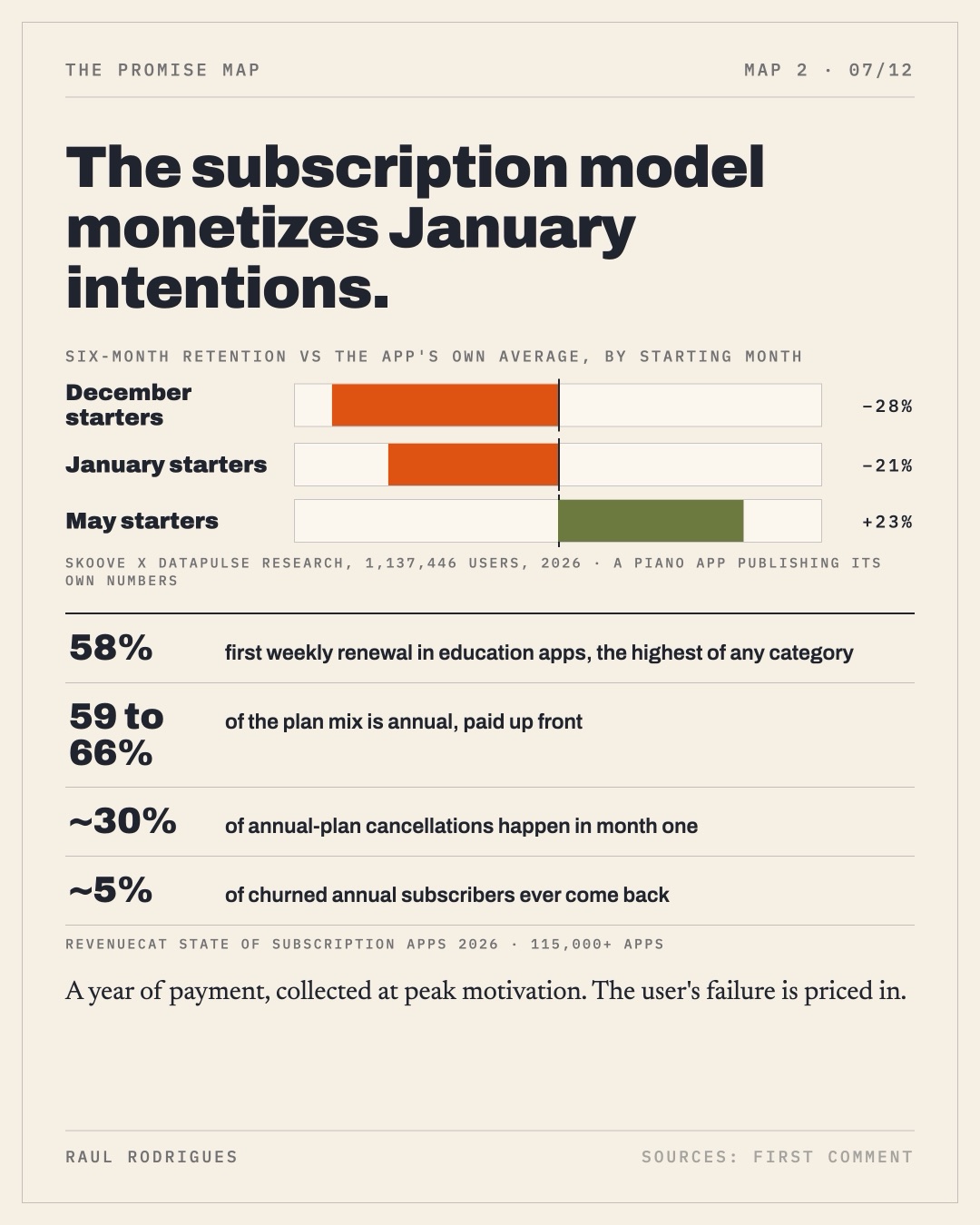
A piano app published its own cohort data, which is rare enough to deserve credit. Across 1.1 million Skoove users, people who started in December kept practising 28 percent less than the average six months later. January starters did 21 percent worse. May starters did 23 percent better.
Now put that next to the subscription economics of the category. Education apps have the highest first weekly renewal rate of any category, 58 percent. Between 59 and 66 percent of their plan mix is annual, paid up front. About 30 percent of annual-plan cancellations happen in month one. And once an annual subscriber churns, only about 5 percent ever come back.
A year of payment, collected at peak motivation. The user's failure is priced in.
7. Of 20 platforms checked, zero publish a learner outcome
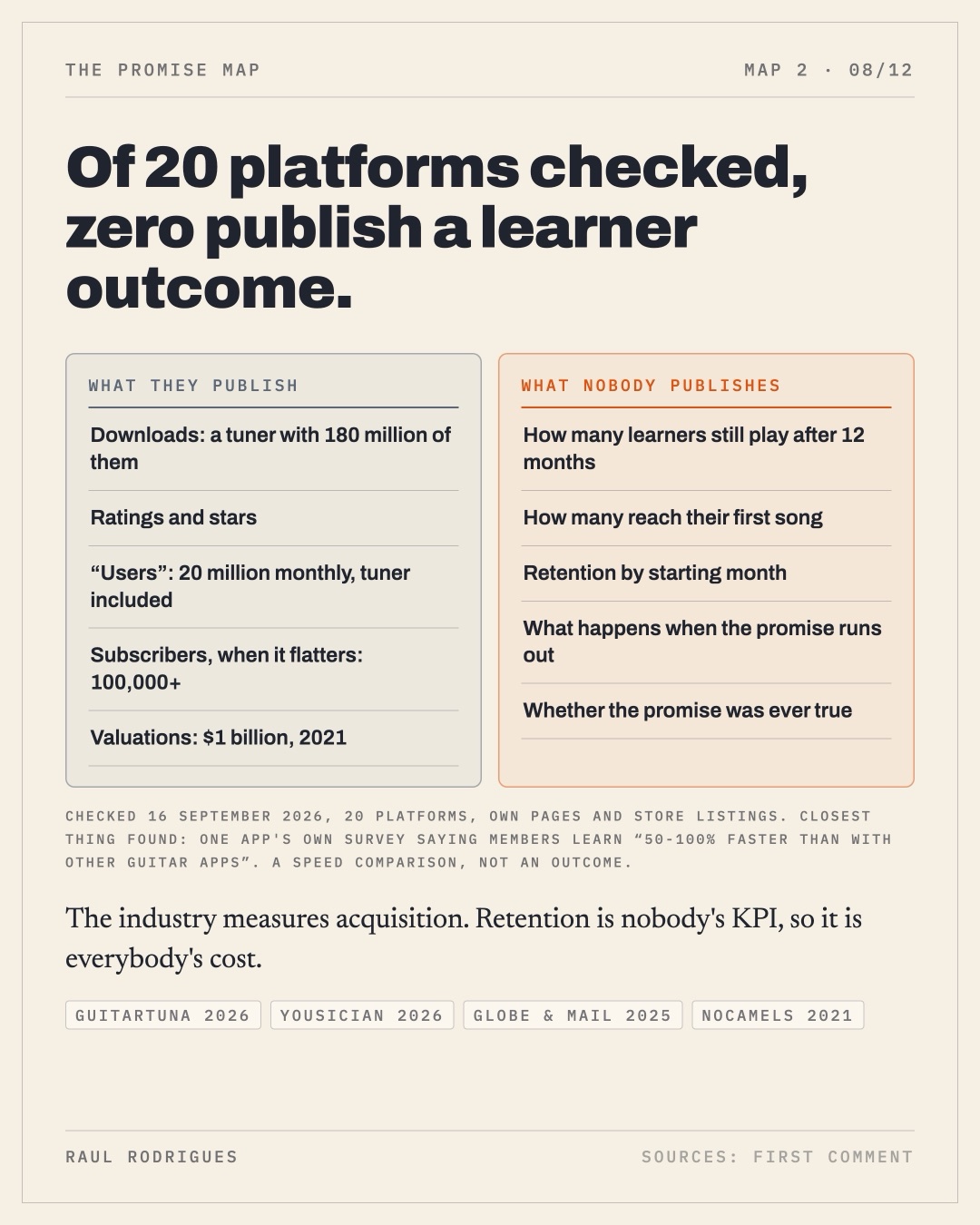
What they publish: downloads (a tuner with 180 million of them), ratings and stars, "users" (20 million monthly, tuner included), subscribers when it flatters, and valuations. What nobody publishes: how many learners still play after twelve months, how many reach their first song, retention by starting month, what happens when the promise runs out.
The closest thing I found was one app's own survey saying its members learn "50-100% FASTER than with other guitar apps". A speed comparison, not an outcome.
The industry measures acquisition. Retention is nobody's KPI, so it is everybody's cost.
8. Four reasons the evidence supports
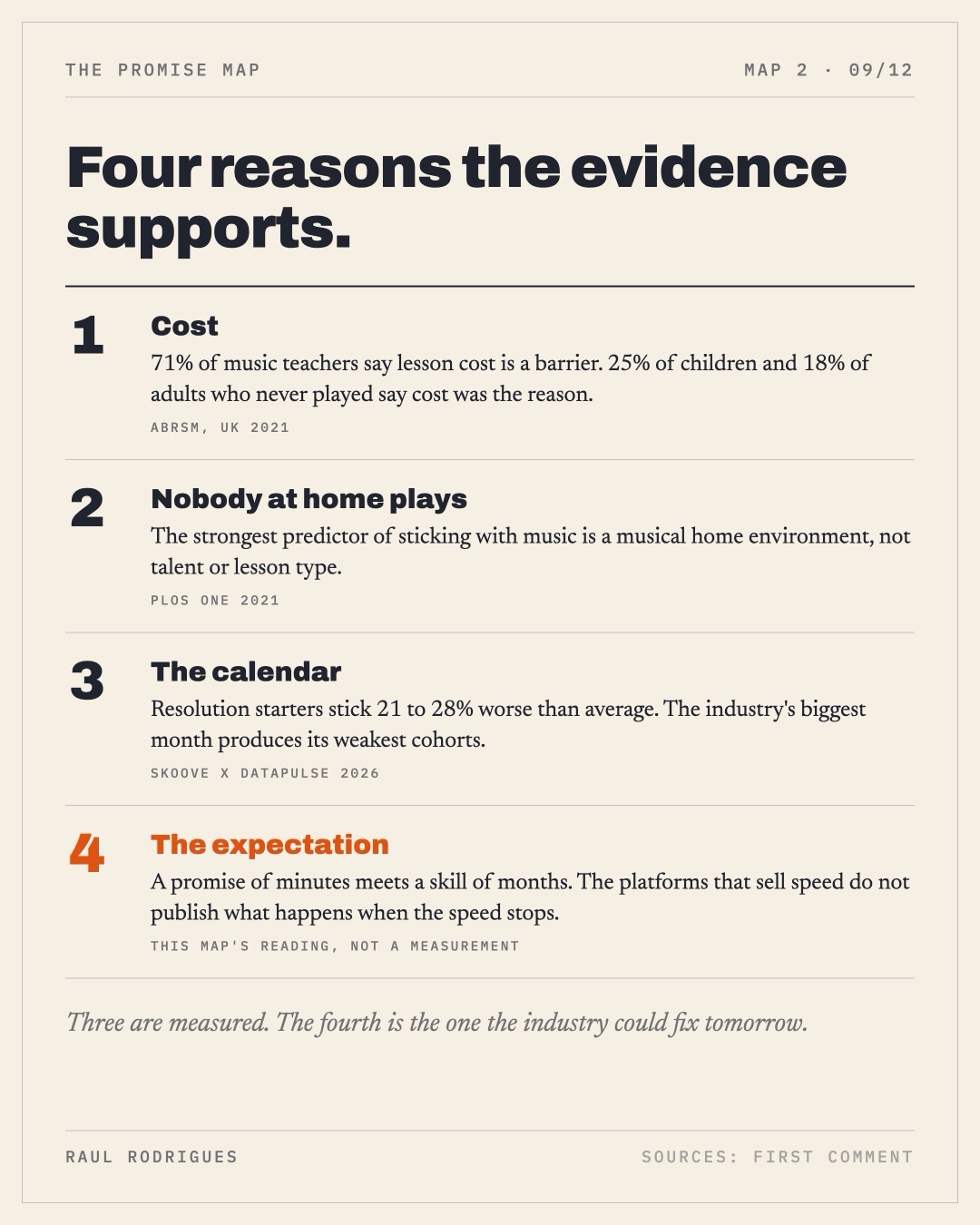
Three are measured. Cost: 71 percent of music teachers say lesson cost is a barrier, and a quarter of children who never played say cost was the reason. Home: the strongest predictor of sticking with music is a musical home environment, not talent or lesson type. The calendar: the industry's biggest month produces its weakest cohorts.
The fourth is my reading, not a measurement, and the slide says so. A promise of minutes meets a skill of months, and the platforms that sell speed do not publish what happens when the speed stops. It is also the one the industry could fix tomorrow.
9. The first year is the biggest unpriced asset in music
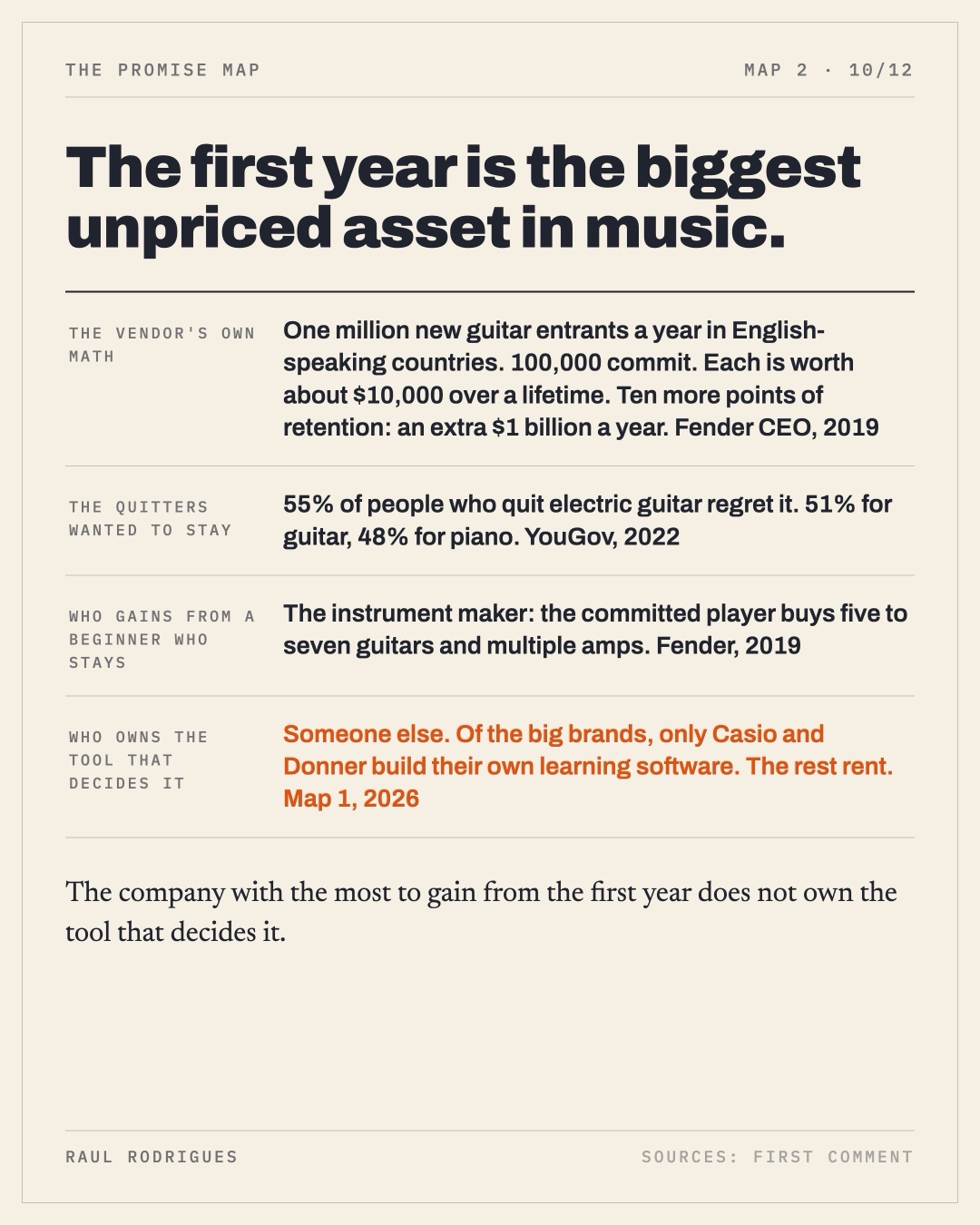
Take the vendor's own math: a million new guitar entrants a year in English-speaking countries, 100,000 who commit, each worth about 10,000 dollars over a lifetime. The quitters wanted to stay: half of them regret it. The company that gains most from a beginner who stays is the instrument maker, because the committed player buys five to seven guitars. And who owns the tool that decides the first year? Someone else. Of the big brands, only Casio and Donner build their own learning software. The rest rent it.
The company with the most to gain from the first year does not own the tool that decides it.
10. Three things this map says
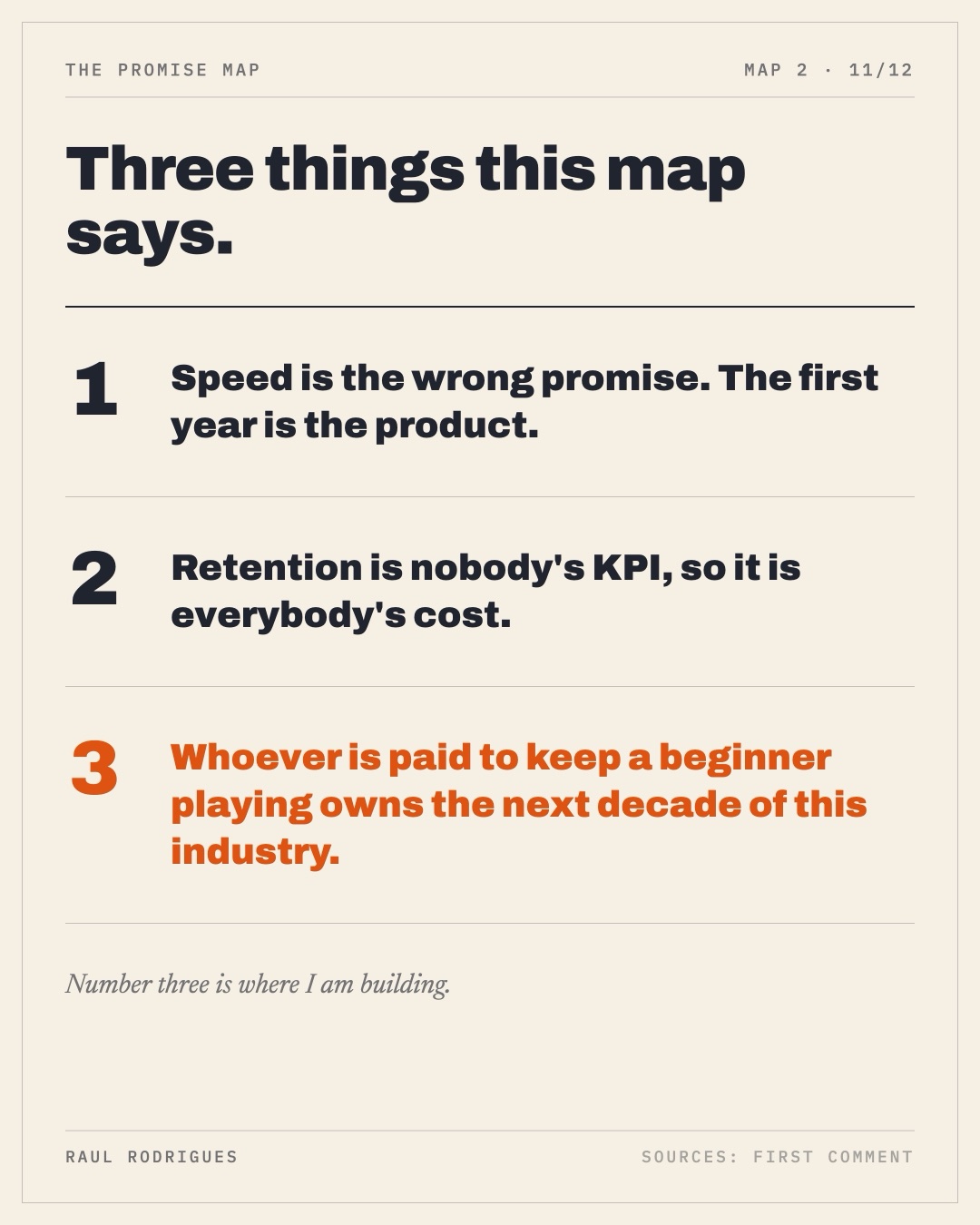
- Speed is the wrong promise. The first year is the product.
- Retention is nobody's KPI, so it is everybody's cost.
- Whoever is paid to keep a beginner playing owns the next decade of this industry.
Number three is where I am building.
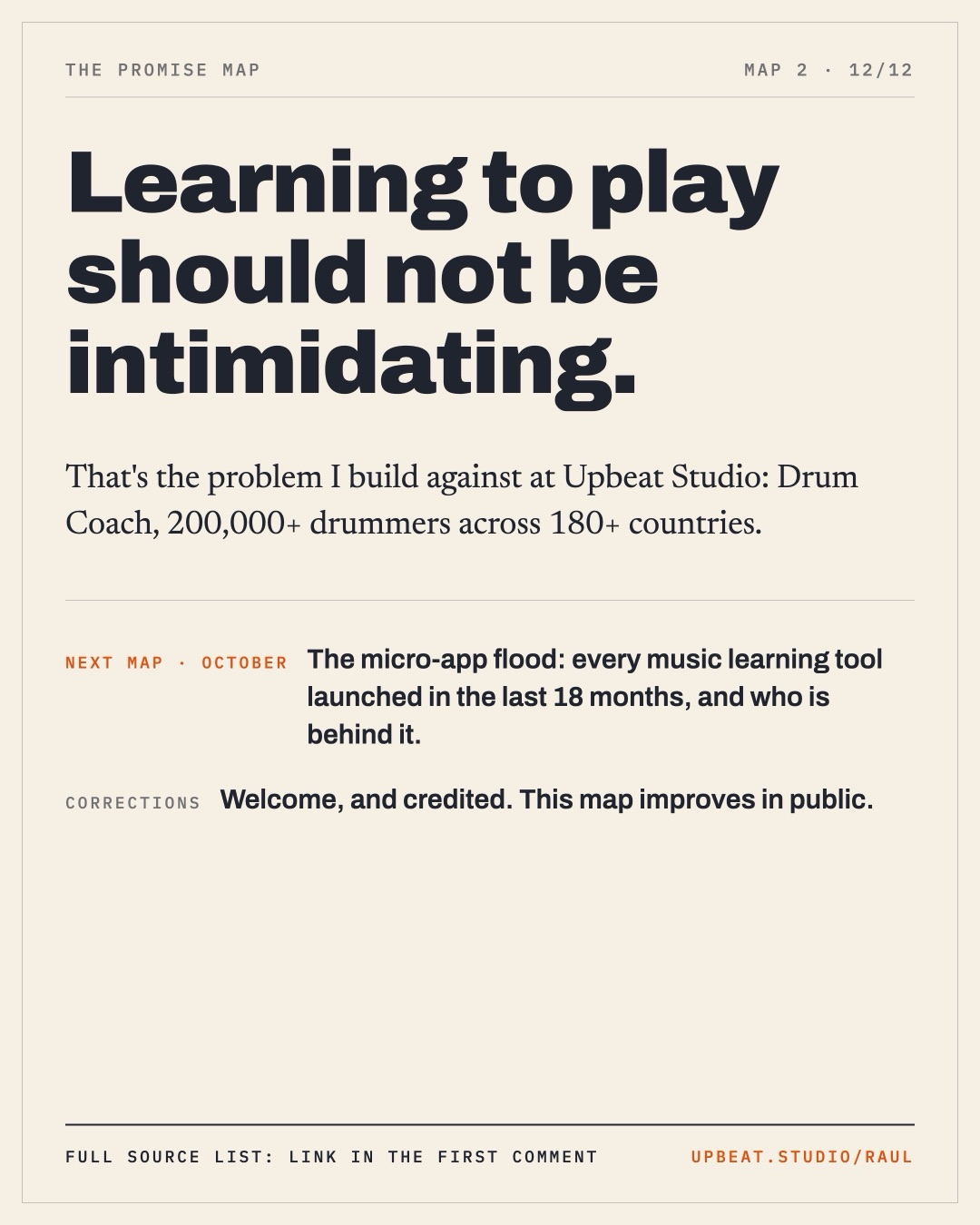
Learning to play should not be intimidating. That is the problem I build against at Upbeat Studio with Drum Coach. Next map, in October: the micro-app flood, every music learning tool launched in the last 18 months and who is behind it.
Download the map: The Promise Map, PDF, 12 pages.
Sources, slide by slide
Every figure on the map with its source and year.
Slides 1 and 4: the 90 percent
- Fender's own press release, 16 October 2018, quoting CEO Andy Mooney: "In 2015, we found more than 90 percent of first-time players abandoned guitar in 12 months, if not the first 90 days." No methodology or sample has been published. spotlight.fender.com/newsroom/news/654
- Mooney's arithmetic (10,000 dollar lifetime value; one million entrants a year in English-speaking countries; 100,000 commit; ten more points of retention as an extra billion dollars a year; committed players buy five to seven guitars): MusicRadar interview, November 2019.
Slide 3: what they promise
Twenty platforms checked on 16 September 2026: Skoove, flowkey, Simply Piano, Guitar Tricks, Piano in 21 Days, Pianote, HDpiano, Synthesia, Fender Play, Duolingo Music, Yousician, Simply Guitar, Guitareo, Drumeo, Singeo, PlayBass, JustinGuitar, Playground Sessions, Melodics, tonebase. Fourteen carry a speed or effort promise on their own website or App Store listing. Four carry none (Skoove, Synthesia, Duolingo Music, Yousician). Two could not be reached (Piano in 21 Days returned an error; PlayBass redirects to a login page). Where a website blocked automated reading (Guitar Tricks, Fender Play, JustinGuitar, Melodics, and Simply Piano's speed wording), the platform's own App Store description was used.
The twelve quotes on the slide, with where each was read:
- flowkey: "Get set up in just two minutes and start playing your first songs straight away." flowkey.com
- Simply Piano: "Personalized 5-Min Workouts ensuring you progress fast and always succeed". App Store listing. The hellosimply.com homepage now reads "progress at your own pace".
- Simply Guitar: "Play songs from day one". hellosimply.com/simply-guitar
- Fender Play: "Begin playing in a few short lessons with learning, practice and feedback activities." App Store listing.
- Pianote: "5 Days To Playing Piano". pianote.com
- Drumeo: "30-Day Independence". drumeo.com
- Guitareo: "Learn to Solo In An Hour". guitareo.com
- Singeo: "Improve your skills in just 10 minutes a day." singeo.com
- HDpiano: "Play your favorite songs from day one". hdpiano.com
- Guitar Tricks: "In a recent survey, members reported learning 50-100% FASTER than with other guitar apps!" App Store listing.
- JustinGuitar Note Trainer: "...helps us learn the fretboard fast, in just 5 minutes a day." App Store listing.
- Melodics: "Just 10 minutes a day can lead to serious improvement." App Store listing.
Slide 5: what independent data says
- About 50 percent of students drop out of music lessons and other musical activities by age 17, most between 15 and 17. Ruth and Müllensiefen, "Survival of musical activities", PLOS One, 2021; 3,303 students in the UK and Germany, 2015 to 2019. journals.plos.org
- Texas: 98,833 sixth-grade band students fell to 14,293 seniors, an 85 percent dropout rate; cohort 1998 to 2005. Byo, "'Modern Band' as school music", International Journal of Music Education, 2018. doi.org/10.1177/0255761417729546
- 86 percent of children and 43 percent of adults actively make music; adult instrument playing declined 20 percent since 2014. ABRSM Making Music Report 2021, 2020 fieldwork; 1,505 adults, 1,503 children, 2,485 teachers. abrsm.org (PDF)
- Regret: 55 percent of people who quit electric guitar, 51 percent guitar, 48 percent piano. YouGov, 3,000 US adult citizens, June to July 2022. yougov.com
Slide 6: Fender
- 103,000 paying subscribers in 2019: Yahoo Finance, November 2019.
- About 110,000 paying before COVID and about 930,000 at the 2020 free-promo peak: Forbes, March 2022.
- Fender Songs discontinued 19 June 2020, seven months after launch: Fender's own support notice.
- No paying-subscriber figure disclosed 2021 to 2026: absence checked across Fender releases, interviews and financial press through August 2026.
- Downgrades, March 2025: S&P Global Ratings and Moody's.
- CEO change, February 2026: PRNewswire.
Slide 7: January
- December starters retain 28 percent below the cross-year average over six months, January 21 percent below, May 23 percent above; 1,137,446 Skoove users. Skoove with DataPulse Research, 2026. First-party, single app, not peer reviewed. skoove.com and datapulse.de
- Education apps: 58 percent median first weekly renewal, the highest category; Education, Travel and Shopping favor annual plans at 59 to 66 percent of the plan mix; about 30 percent of education apps' annual-plan cancellations happen in month one; churned annual subscribers reactivate at about 5 percent across categories, education within a 3 to 8 percent band. RevenueCat, State of Subscription Apps 2026, 115,000+ apps, 2025 data. revenuecat.com and renewal rates by category
Slide 8: what gets published
- None of the 20 platforms checked publishes a learner outcome or retention metric on its marketing pages or store listing, as of 16 September 2026.
- GuitarTuna: 180 million downloads, self-reported. guitartuna.com/about
- Yousician's "20 million" monthly users includes the tuner; Yousician's revenue is EUR 53.0M for 2025 per the Finnish statutory registry via Finder.fi.
- Musora: 100,000+ paid subscribers, Globe and Mail, 2025.
- Simply: 1 billion dollar valuation, NoCamels, 2021.
Slide 9: four reasons
- Cost: 71 percent of music teachers say lesson cost is a barrier; 25 percent of children and 18 percent of adults who never played say it was the cost. ABRSM 2021, above.
- Home environment: the strongest retention predictor in the survival analysis. PLOS One 2021, above.
- The calendar: Skoove and DataPulse 2026, above.
- The expectation: this map's reading, labelled as such on the slide, not a measurement.
Slide 10: the money on the table
- Mooney's math and the five-to-seven-guitars line: MusicRadar 2019, above.
- Regret: YouGov 2022, above.
- Only Casio and Donner build their own learning software: Map 1, September 2026 (Casio Music Space, 2022; Donner Play).
Slide 12
- Drum Coach: 200,000+ drummers across 180+ countries. upbeat.studio, 2026.
Corrections log
Nothing yet. If you find a figure that is wrong, outdated or missing its context, message me on LinkedIn. Verified corrections are folded into the map and credited here, as happened with Map 1 before it published.
About the author
I am Raul Rodrigues, a drummer, a former music-school founder and the founder of Upbeat Studio in Valencia, where we build Drum Coach and Drum Notes. I map the music learning industry because nobody else publishes it, and because the thing I care about most, keeping beginners playing through their first year, is the thing this industry measures least. Find me on LinkedIn.
YOU MIGHT ALSO LIKE
How Atlanta Makes Drummers
Atlanta produces a remarkable number of working drummers. Not by accident: the city has an unusual concentration of institutions that teach rhythm to children and keep teaching it into adulthood.
The Five Pillars of Drumming: What Every Beginner Should Practice
Technique, coordination, styles, reading, and improvisation — the five pillars every beginner drummer should balance. A recap from our live session.
How to Read Drum Sheet Music: The Ultimate Guide to Rhythm Literacy
Unlock the language of rhythm! Learn how to read drum sheet music with our step-by-step guide. Master the staff, symbols, and counting systems today.