
The Five Pillars of Drumming: What Every Beginner Should Practice
Technique, coordination, styles, reading, and improvisation: the five pillars every beginner drummer should balance. A recap from our live session.
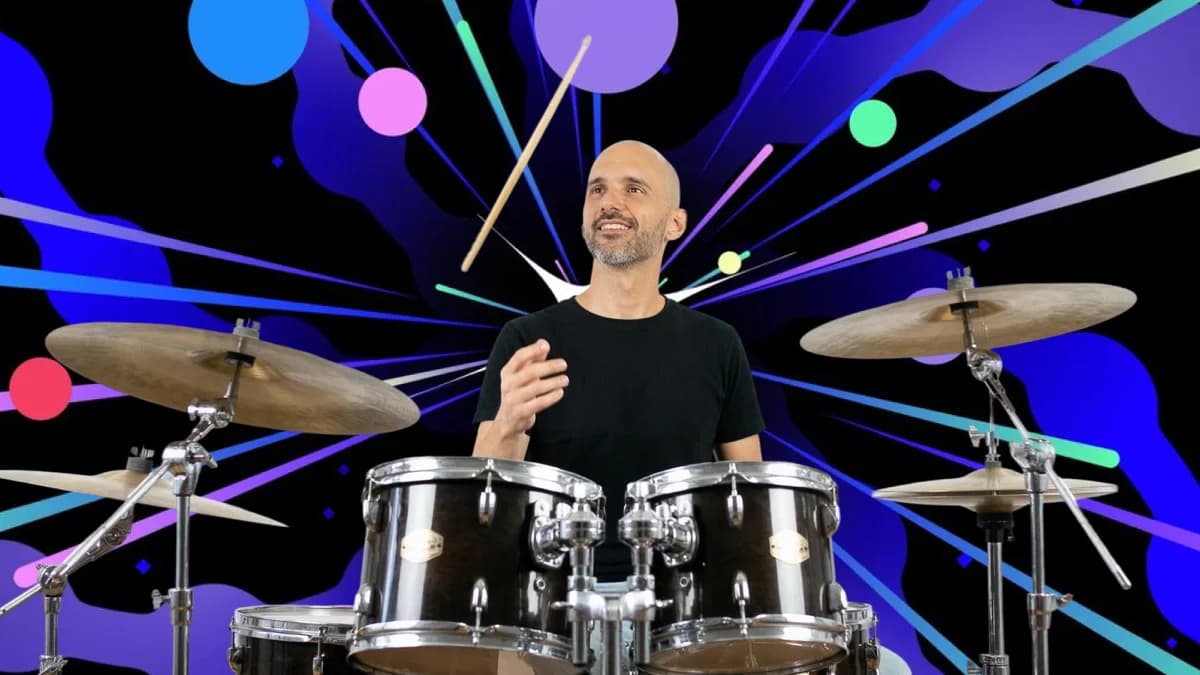
Drumming can feel overwhelming when you're starting out. There are rudiments, styles, coordination drills, sheet music, and the constant pressure to just sound good. Where do you even begin?
In our latest live session, we broke drumming down into five essential pillars: technique, coordination, styles, reading, and improvisation. Think of them the way a professional athlete thinks about training — a runner doesn't only work on speed; they also work on strength, endurance, and tactics. Drumming is no different. If you understand these five areas, you can balance your practice and actually see progress instead of spinning in circles.
Watch the full session: Five Pillars of Drumming — Live Practice Session on YouTube.
Pillar 1: Technique
Technique is the foundation of everything else. It's what prepares your body to play cleanly and effortlessly — without strain, without injury, and without fighting the instrument.
How to improve it: Start with simple, focused exercises. Play 16th notes with one hand, then the other. Can both hands sound identical? Are they equally strong? That's the baseline. For a deeper dive into grip and posture, see our guide on drumming techniques for beginners.
Common mistake: Treating technique as the goal instead of the vehicle. Technique serves the music, not the other way around. You're not practicing to have perfect hands in isolation — you're practicing so your ideas can flow freely when you play.
Pillar 2: Coordination
Coordination is your ability to control multiple limbs at the same time — both independently and in sync. It's what lets you play a steady ride pattern while your kick drops on the downbeats and your snare lands on 2 and 4.
How to practice it: Isolate one limb, then slowly add others. Start with your right hand on a steady pulse. Add your left hand. Then your right foot. Build the pattern one piece at a time instead of trying to swallow it whole.
Why it matters: Good coordination is what separates a drummer who plays at the kit from one who plays through it. It's the difference between rigid patterns and fluid musicality.
Pillar 3: Styles
Every genre has its own vocabulary. A jazz drummer lives in improvisation and dynamic control. A metal drummer leans on speed and precision. A funk drummer is all about pocket and subdivision.
How to choose a style: Start with the music you already love. You'll practice more, you'll listen more, and your technique will develop in a context that feels natural and motivating.
Common pitfall: Trying to master five genres at once. Pick one, go deep, and branch out later. Depth beats breadth when you're building fundamentals.
Pillar 4: Reading
Reading music is often skipped because it feels academic — but it's one of the highest-leverage skills you can develop. Once you can read, you can learn songs faster, understand complex rhythms, and communicate with other musicians in a shared language.
How to get started: Begin with basic drum notation — learn what a quarter note, an eighth note, and a rest look like. Our complete guide to reading drum notation covers exactly that, and every example on it plays out loud so you can hear what you are reading. Then practice reading simple grooves out loud before you even play them, or drill it as a game in the free Drum Notation Trainer. Tools like the Drum Notes web app let you see rhythms visually so you can connect what you're playing to what's on the page.
Key insight: Don't rush. Reading develops over years, not weeks. Fifteen minutes a day will take you further than a three-hour cram session.
Pillar 5: Improvisation
Improvisation is where your personality comes through. It's the pillar most beginners avoid — because it feels scary, because there are no "right notes," because you're afraid of sounding bad.
How to practice it: Start simple. Take a basic groove and vary it — add a ghost note, move the snare, change the subdivision. Play along with a track and try small variations. Improvisation isn't about being a virtuoso; it's about giving yourself permission to explore.
Common mistake: Waiting until you're "good enough" to improvise. You'll never feel ready. Start now, even if it's ugly. Ugly improvisation is how you find your voice.
How to Balance the Five Pillars
Here's the honest truth: you can't give equal time to all five every day. The balance shifts depending on your level, your goals, and the style you're pursuing.
- Complete beginner? Lean heavily on technique and coordination. Those two carry everything else.
- Intermediate drummer hitting a plateau? Add reading and start improvising — that's usually where growth comes from.
- Playing in a band already? Styles and improvisation become your priority. Technique is still non-negotiable, but it shifts into maintenance mode.
Pick one pillar to focus on this week. Not five. One. Spend 15–20 minutes a day on it and see how your playing shifts.
If you want structured practice that balances these pillars for you, Drum Coach builds daily routines that rotate through technique, coordination, and reading so you don't have to plan it yourself.
Conclusion
The five pillars — technique, coordination, styles, reading, and improvisation — aren't a ranking. They're a map. Every great drummer you admire has developed all five, but they got there by focusing on one at a time and being patient with the process.
Pick your pillar. Put in the 20 minutes. Come back next week and see what changed. And if you want to practice with us, we go live every Wednesday — join the next session.
Frequently Asked Questions
What is the most important skill for a beginner drummer?
Technique comes first because it's the foundation everything else sits on. But technique alone isn't enough — you need coordination to apply it and a style to apply it in.
How do I choose a drumming style to focus on?
Pick the music you already love listening to. Motivation beats theory. If you love rock, practice rock. If you love jazz, start there. You'll learn faster in a context that excites you.
Do I really need to learn to read music to be a good drummer?
No, but it will accelerate everything else. Reading opens up the world of sheet music, makes it easier to learn new songs, and lets you communicate with other musicians. Start simple and build gradually.
How long should I practice each pillar?
For most beginners, 20 minutes of focused practice on one pillar beats an unfocused hour. Rotate pillars across the week rather than trying to hit all five every day.
I'm scared to improvise. How do I start?
Start tiny. Take a groove you already know and change one thing — a ghost note, a different hi-hat pattern, a rest where there used to be a note. Improvisation isn't about being bold; it's about allowing yourself to experiment.
YOU MIGHT ALSO LIKE

Most Drum Schools Won't Tell You What a Lesson Costs. I Read 615 of Them.
I read the websites of 615 drum schools and teachers in six US states. Only 14% say what one lesson costs, 29% let you work out the price of an hour, and a typical hour runs $57.50 to $66.67. By Raul Rodrigues.

The Micro-App Flood: How Many Music Learning Apps Now Launch, and Who Uses Them
Map 3 of the online music learning industry. About 100 new music learning apps a year until 2024, 557 in the first nine months of 2026. 87% of the new ones have fewer than 10 ratings. The top of the store has not moved. By Raul Rodrigues.

The Promise Map: What Music Learning Apps Promise Beginners, and What the Data Says Happens
Map 2 of the online music learning industry. Eight of twenty platforms name a time to your first song. Two in three people who learned an instrument no longer play. Nobody publishes what happens in between. By Raul Rodrigues.