
The Online Music Learning Landscape: The First Public Map of the Industry
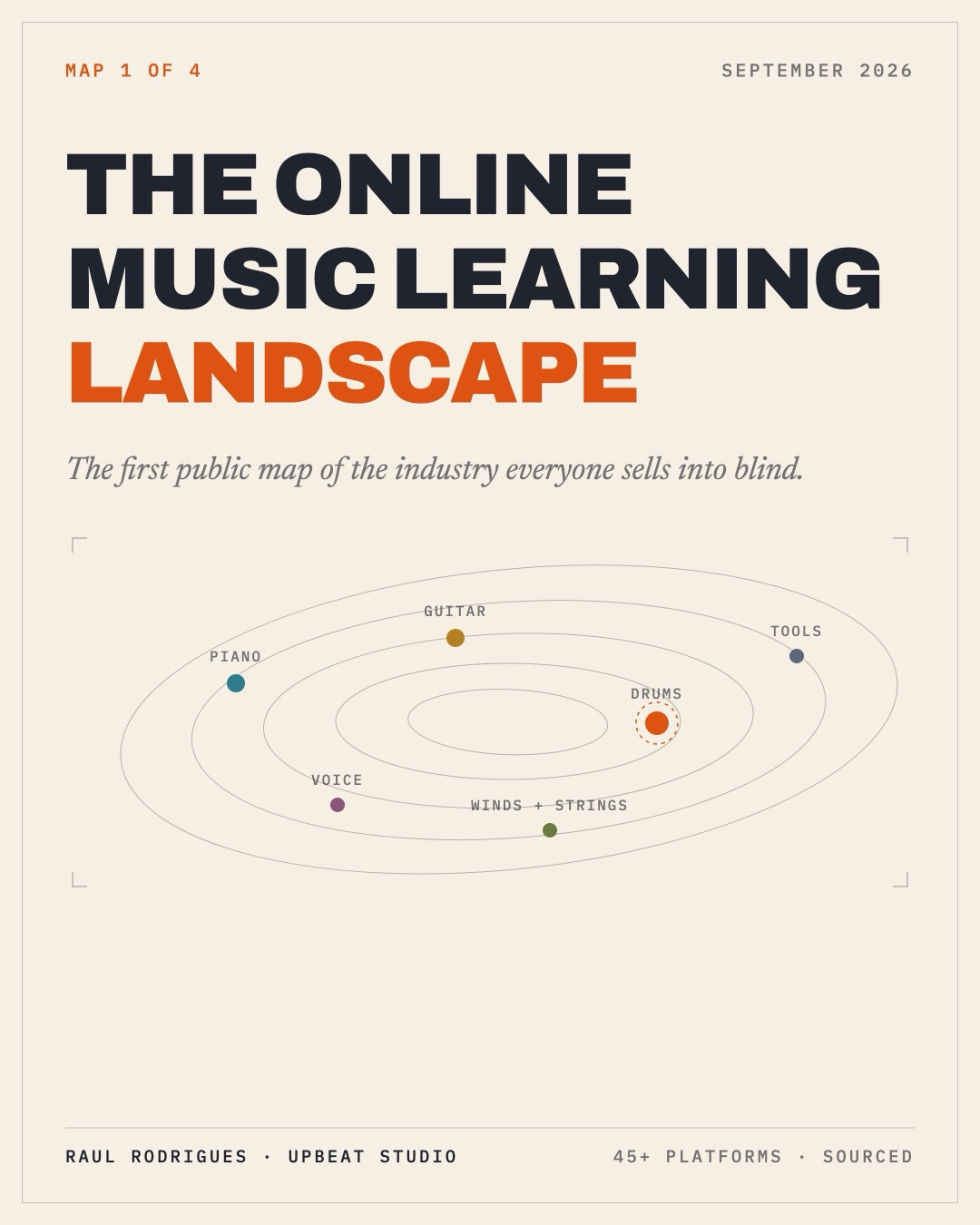
Map 1 of the online music learning industry. More than 45 platforms. Who owns them, how they make money, who walked away. Every figure with its source. By Raul Rodrigues.

The Online Music Learning Landscape
Map 1 of 4. Published on LinkedIn on 2 September 2026. On this site since 16 September. By Raul Rodrigues, founder of Upbeat Studio.
Nobody publishes this industry. Not the instrument makers. Not the platforms. Not one analyst. Millions of beginners a year walk into it, and there is no picture of what they walk into. So I mapped it.
This map covers more than 45 platforms. Who makes them. Who owns them. How they make money. Who came in and left. Every number has a source and a year. Estimates are labelled as estimates. The twelve slides are below, with the text behind each one. The sources are at the end, slide by slide. The PDF is at the bottom.
Five things the data says:
- Every app war you have heard of is fought over two instruments. Piano and guitar take 65 to 80 percent of beginner demand. Drums take about 8 percent.
- The apps look independent. The ownership does not.
- The industry hides its numbers. They surface in two places only: where a founder talks, and where European law forces a filing.
- Instrument makers rent their learning software. Of the big brands, only Casio and Donner build their own.
- Microsoft, Spotify and Ubisoft walked in and walked out. Distribution alone does not crack this category.
The rules of this map
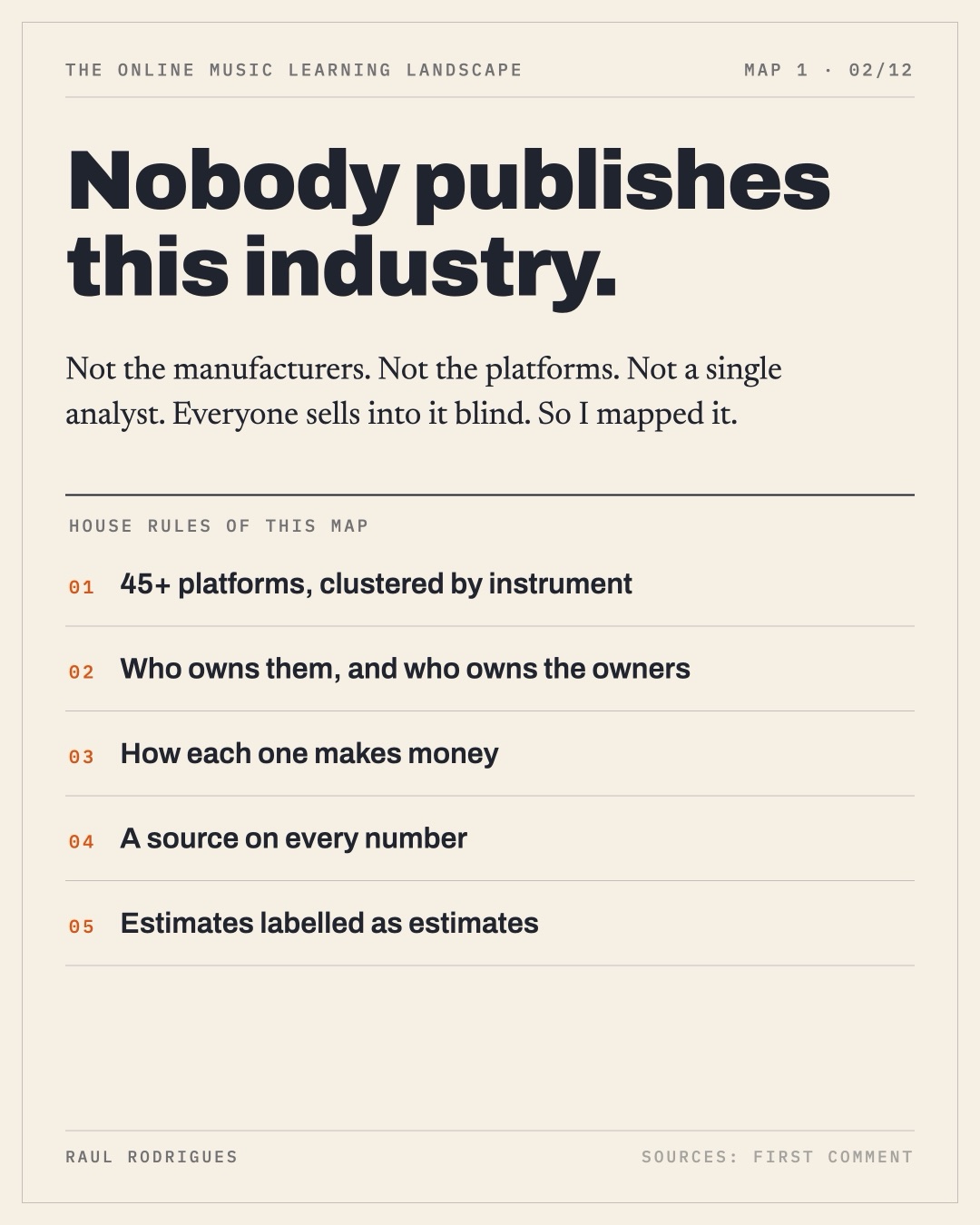
Five rules. More than 45 platforms, clustered by instrument. Who owns them, and who owns the owners. How each one makes money. A source on every number. Estimates labelled as estimates. Facts about ownership and business models outrank financial figures, because categories can be checked and revenue guesses cannot.
The map
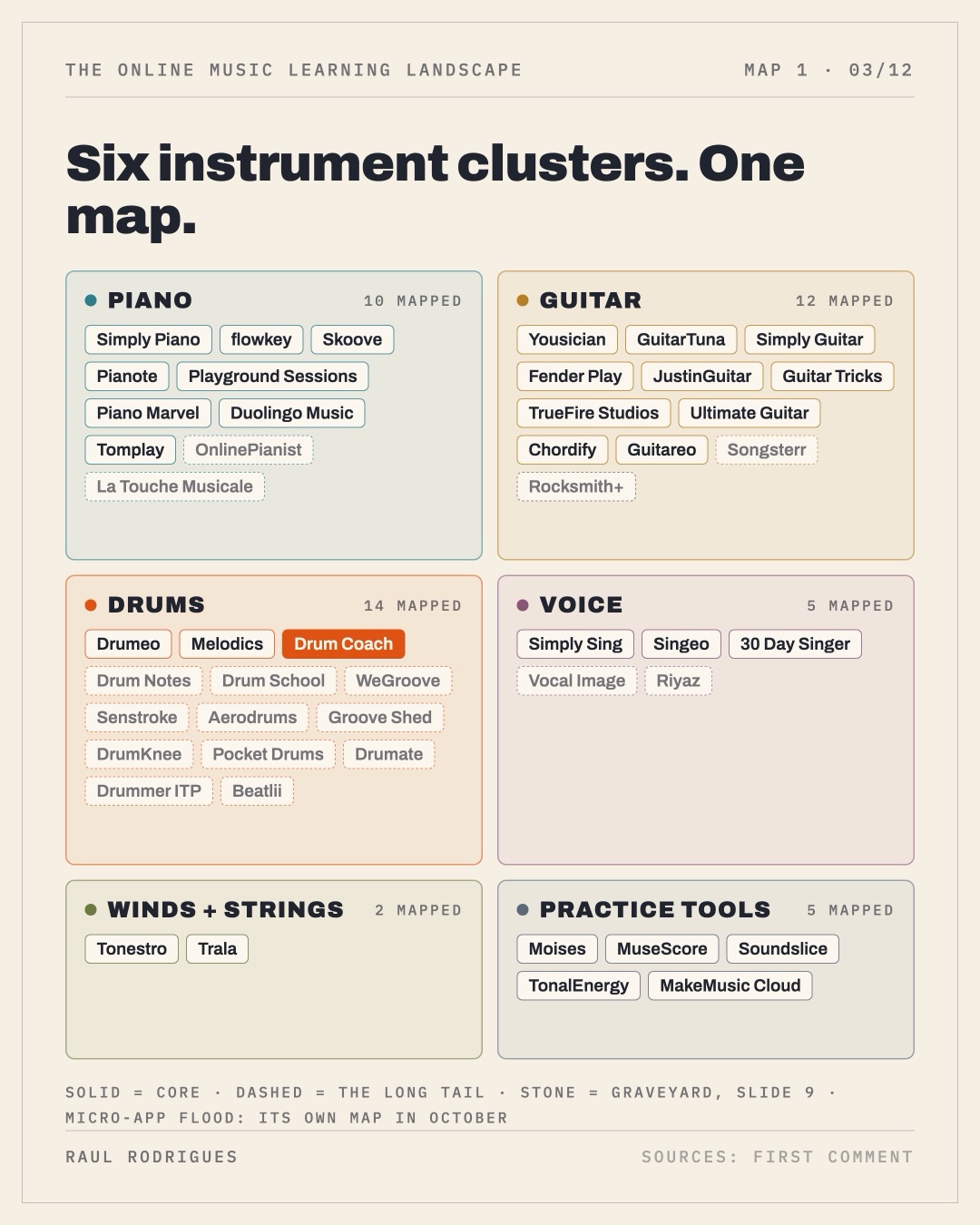
Six clusters: piano, guitar, drums, voice, winds and strings, and practice tools. Solid chips are the core platforms with public scale signals. Dashed chips are the long tail. Stone chips are companies that have closed. On 26 August 2026 I checked every app on this slide against its App Store seller of record, so each chip sits under the company that actually publishes it.
Where beginners go
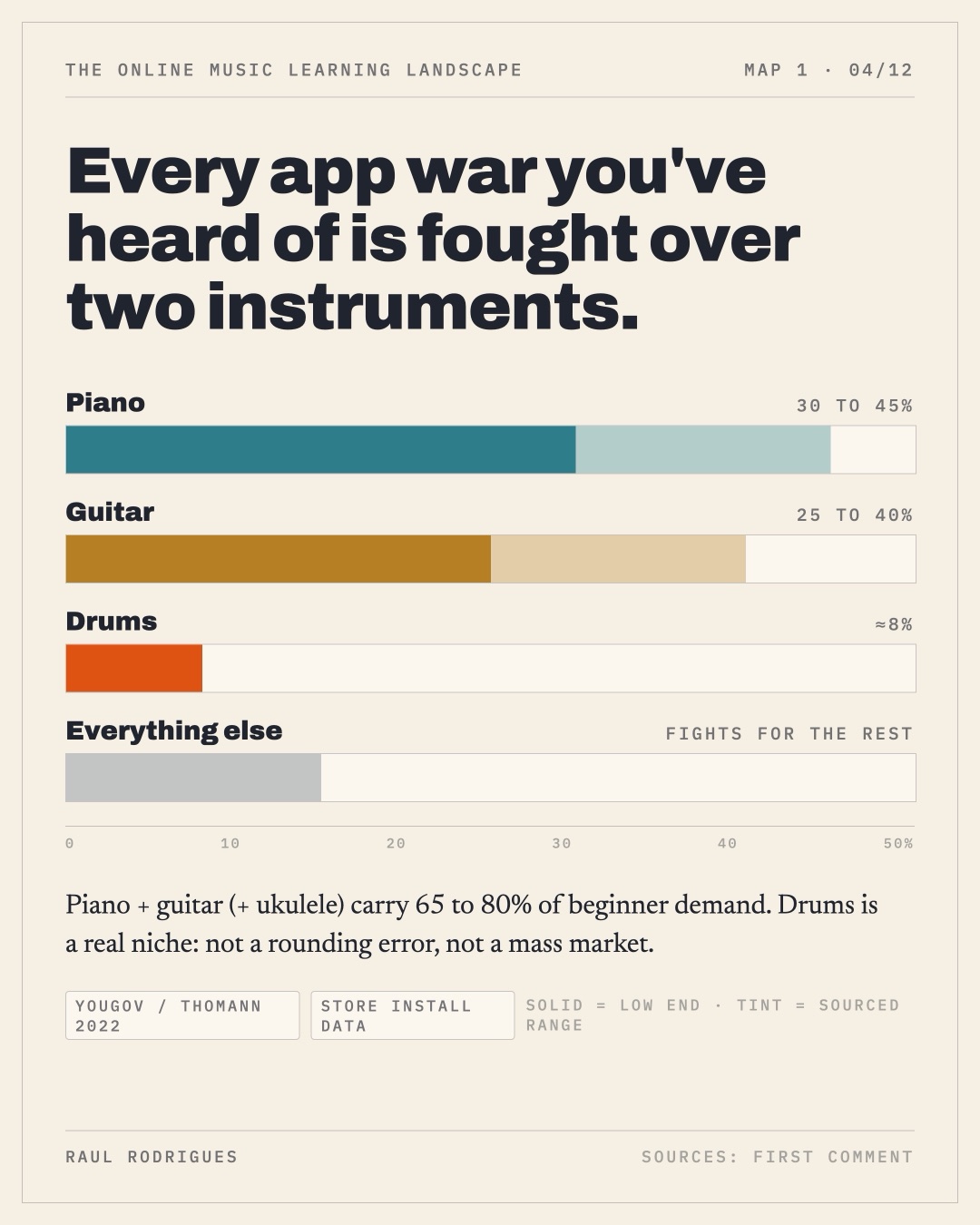
Piano takes 30 to 45 percent of beginner demand. Guitar takes 25 to 40 percent. Drums take about 8 percent. These are estimates, triangulated from a YouGov survey of 3,000 US adults, Fender's study of new guitar players, and app install data. The point is simple. Almost every product in this industry is built for two instruments. Drums are a real niche: not a rounding error, and not a mass market.
The apps look independent. The ownership does not.
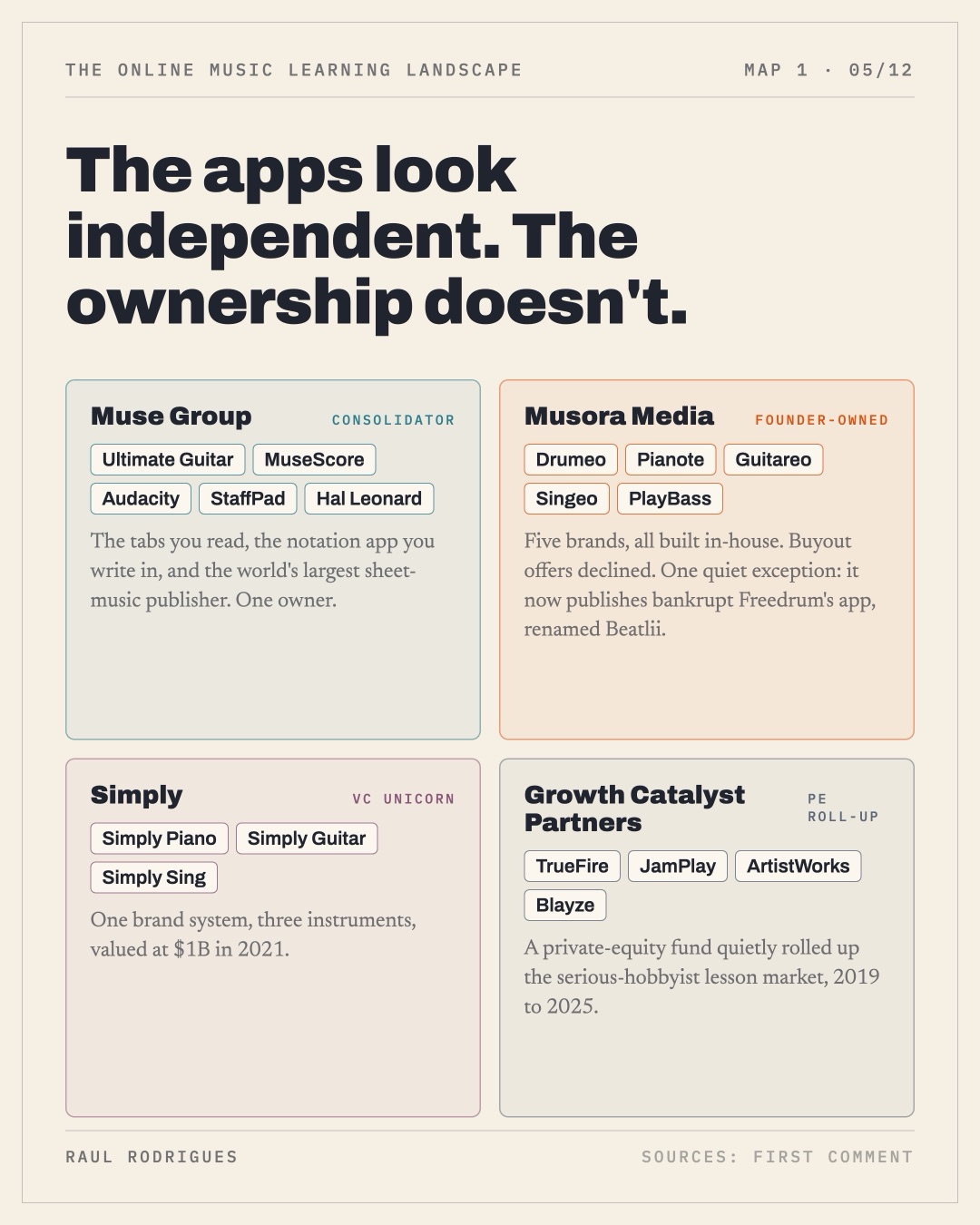
Muse Group owns the tabs you read (Ultimate Guitar), the notation app you write in (MuseScore), Audacity, StaffPad and the world's largest sheet music publisher, Hal Leonard. Musora built five brands in house: Drumeo, Pianote, Guitareo, Singeo and PlayBass. It has declined buyout offers. One quiet exception: it now publishes the app of bankrupt Freedrum, renamed Beatlii. Simply runs three instruments under one brand and was valued at one billion dollars in 2021. A private equity fund, Growth Catalyst Partners, rolled up TrueFire, JamPlay, ArtistWorks and Blayze between 2019 and 2025.
An industry that hides its numbers
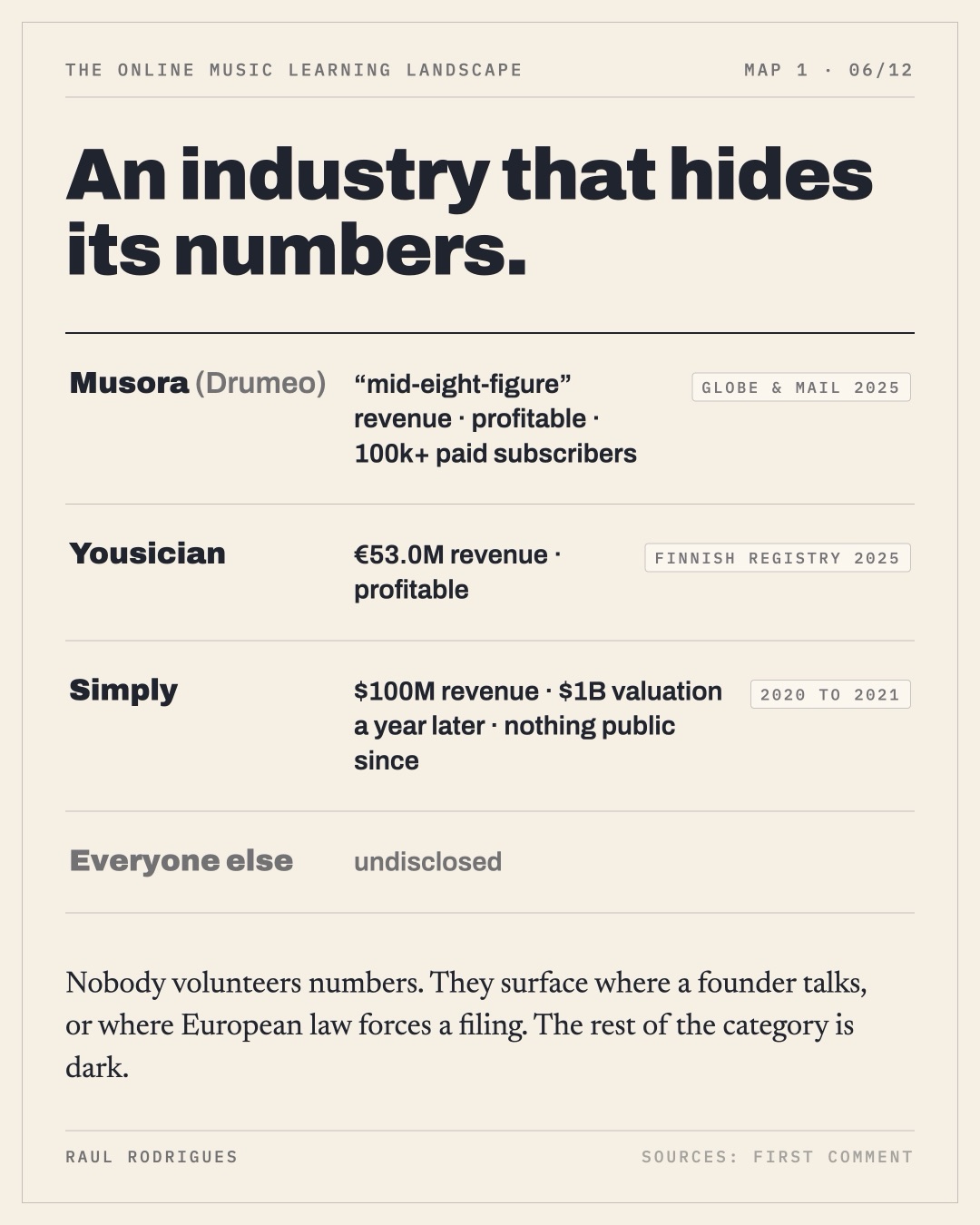
Three companies have numbers you can check. Musora, the company behind Drumeo, says on the record that it makes "mid-eight-figure" revenue, is profitable and has more than 100,000 paid subscribers. Yousician's revenue is 53.0 million euros for 2025, with a profit, because Finnish law makes it file accounts. Simply reported 100 million dollars of revenue in 2020 and a one billion dollar valuation a year later, and nothing since. Everyone else is undisclosed. Numbers surface where a founder talks, or where European law forces a filing. The rest of the category is dark.
How the money is made
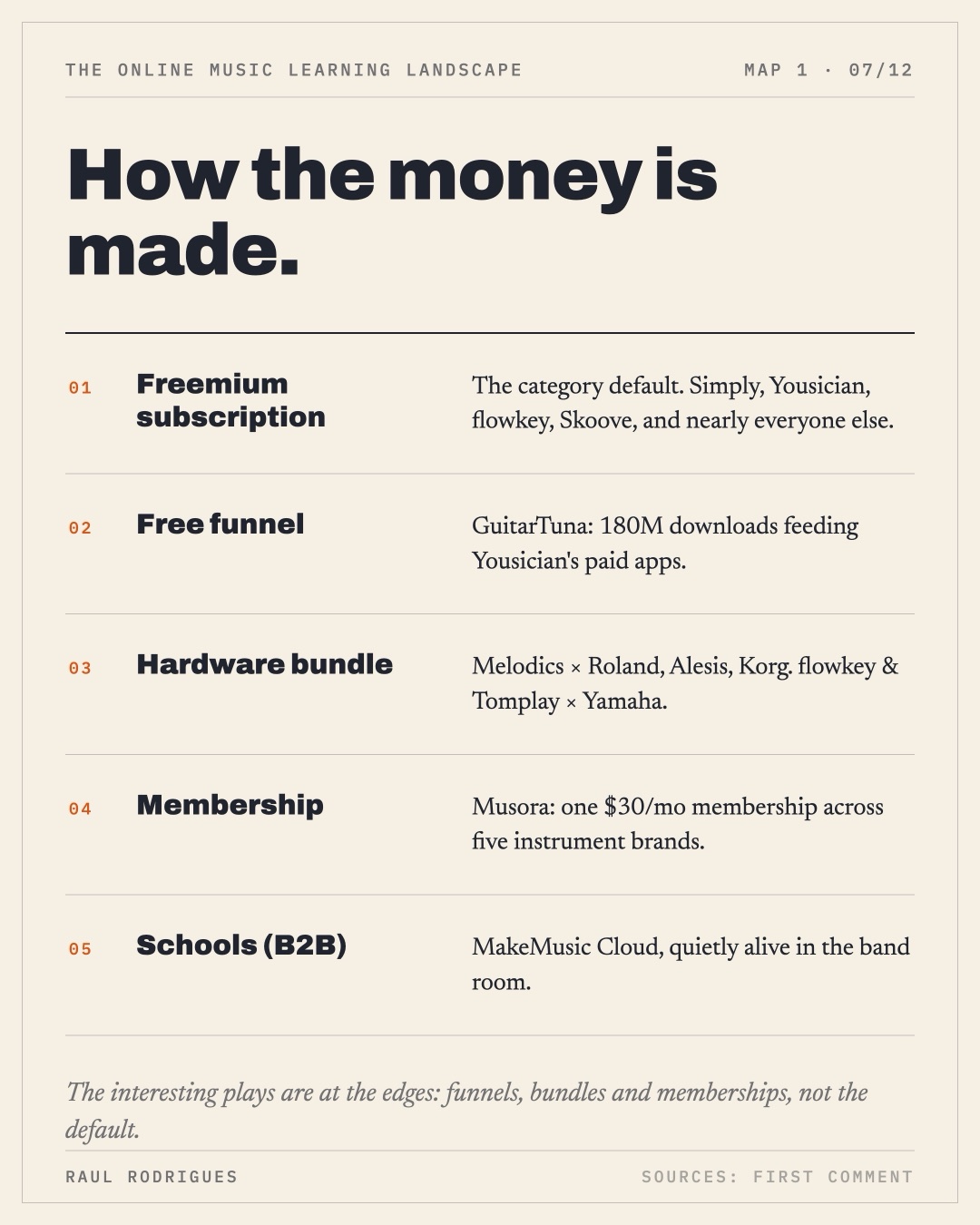
Freemium subscription is the default. The interesting plays are at the edges. A free funnel: GuitarTuna has 180 million downloads and feeds Yousician's paid apps. Hardware bundles: Melodics with Roland, Alesis and Korg; flowkey and Tomplay with Yamaha. A membership: Musora sells one plan across five instrument brands. Schools: MakeMusic Cloud lives quietly in the band room.
Manufacturers rent. They don't build.
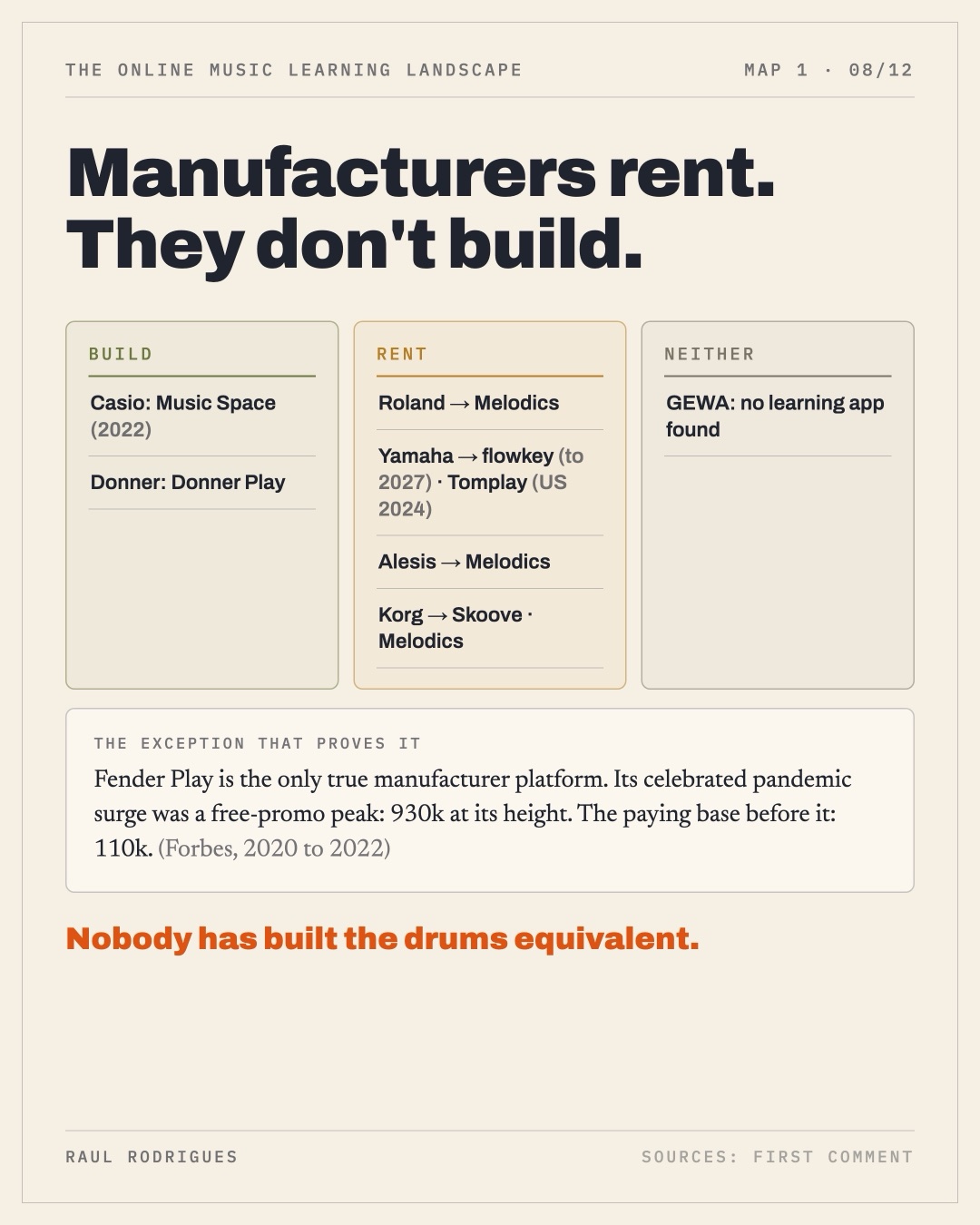
Only two instrument makers ship their own learning software: Casio, with Music Space, and Donner, with Donner Play. Roland, Yamaha, Alesis and Korg bundle somebody else's app. GEWA has none that I could find. Fender built the only true manufacturer platform, Fender Play. Its famous pandemic surge was a free promotion: about 930,000 subscribers at the peak. The paying base before it was about 110,000. Nobody has built the drums equivalent.
Distribution alone doesn't crack this category
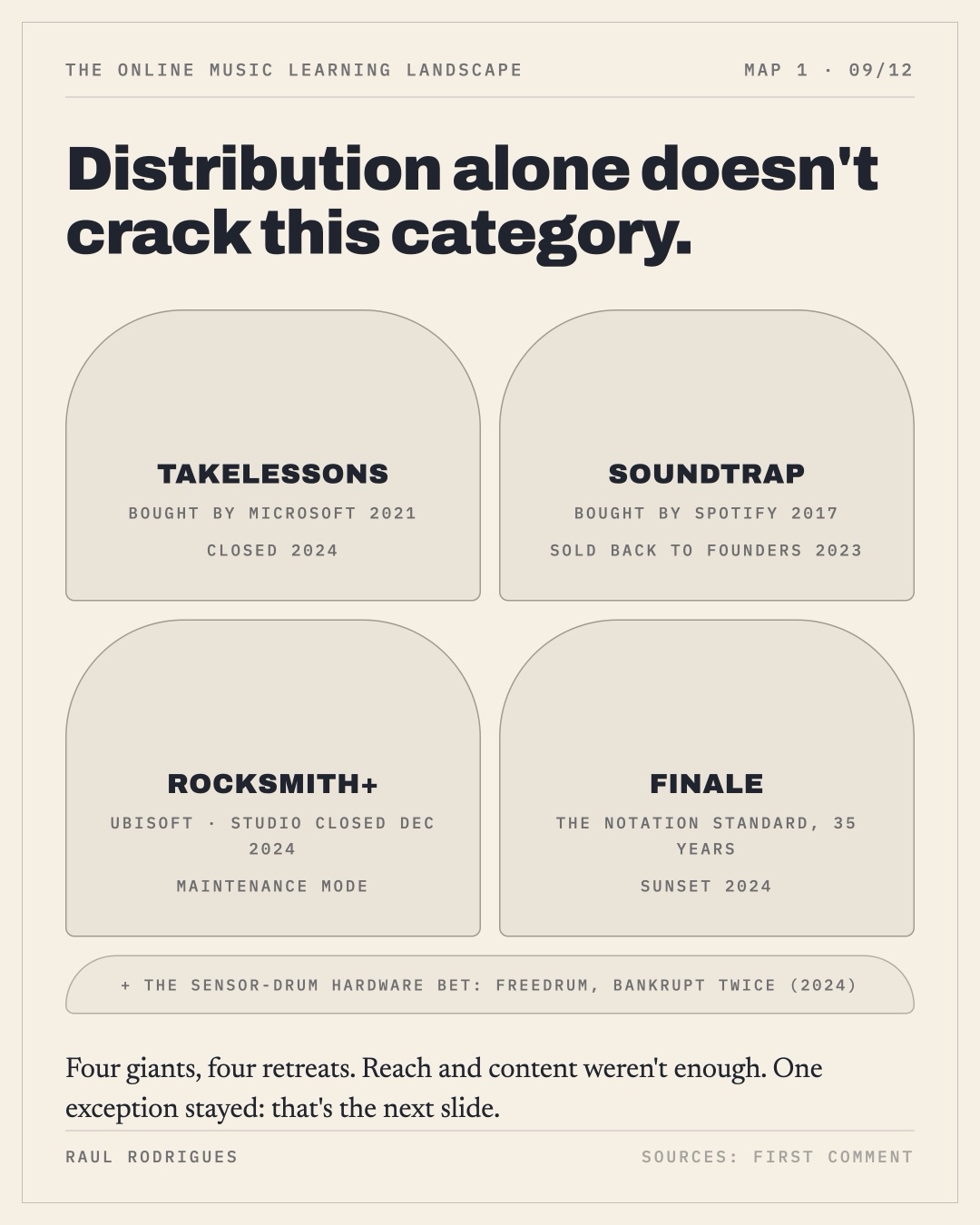
Microsoft bought TakeLessons in 2021 and closed it in 2024. Spotify bought Soundtrap in 2017 and sold it back to its founders in 2023. Ubisoft built Rocksmith+; the studio behind it closed in December 2024 and the service runs with nobody developing it. Finale, the notation standard for 35 years, was sunset in 2024. Freedrum, the sensor drum startup, went bankrupt twice. Four giants, four retreats. Reach and content were not enough.
One tourist stayed
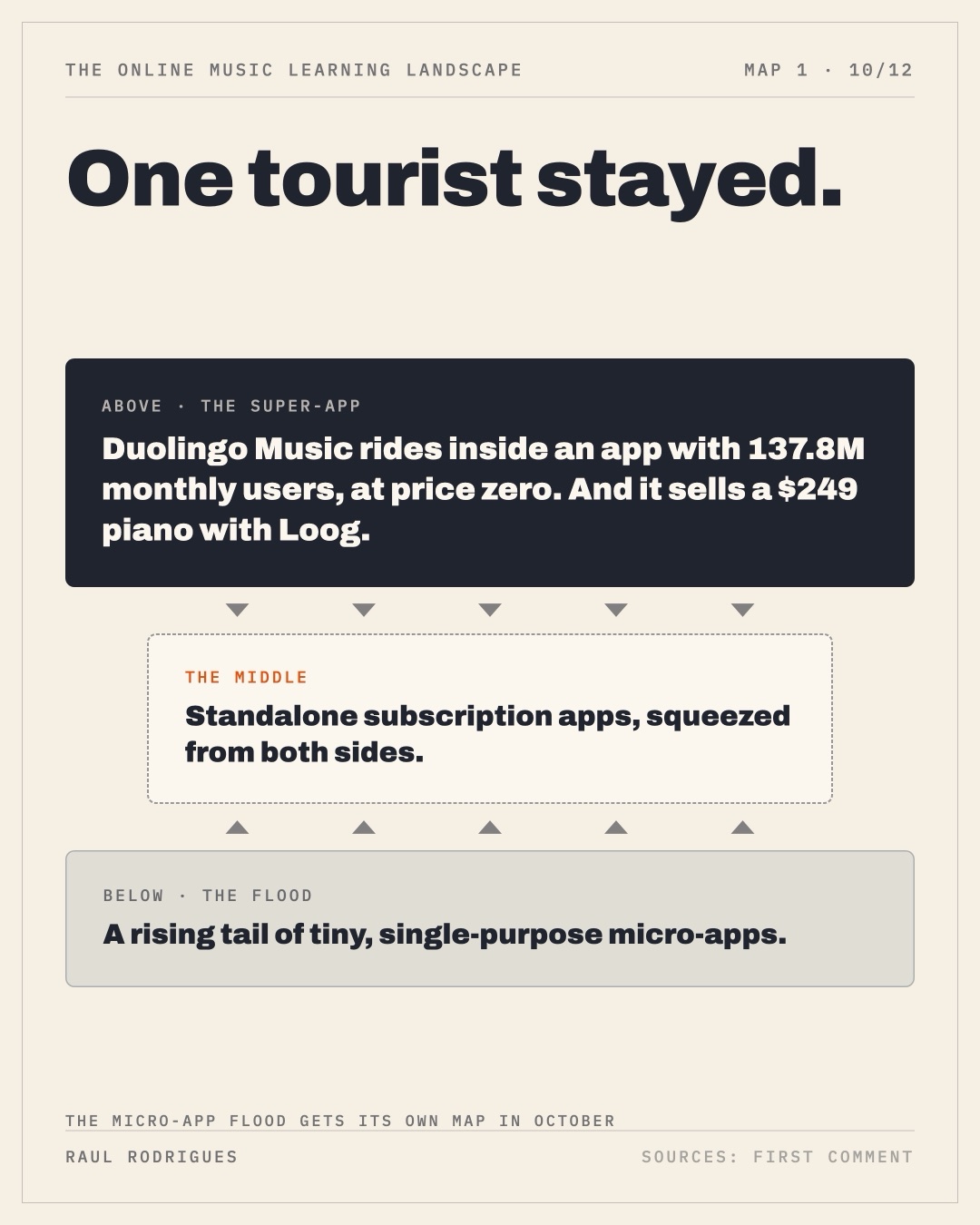
Duolingo put a music course inside an app with 137.8 million monthly users, at price zero, and started selling a 249 dollar piano with Loog. Its annual report says the music course has not generated material revenue. That is worse news for paid apps than a competitor would be: it resets a beginner's reference price to nothing. Above the standalone apps sits a super-app. Below them, a rising tail of tiny single-purpose tools. The middle is being squeezed from both sides.
Three things this map says
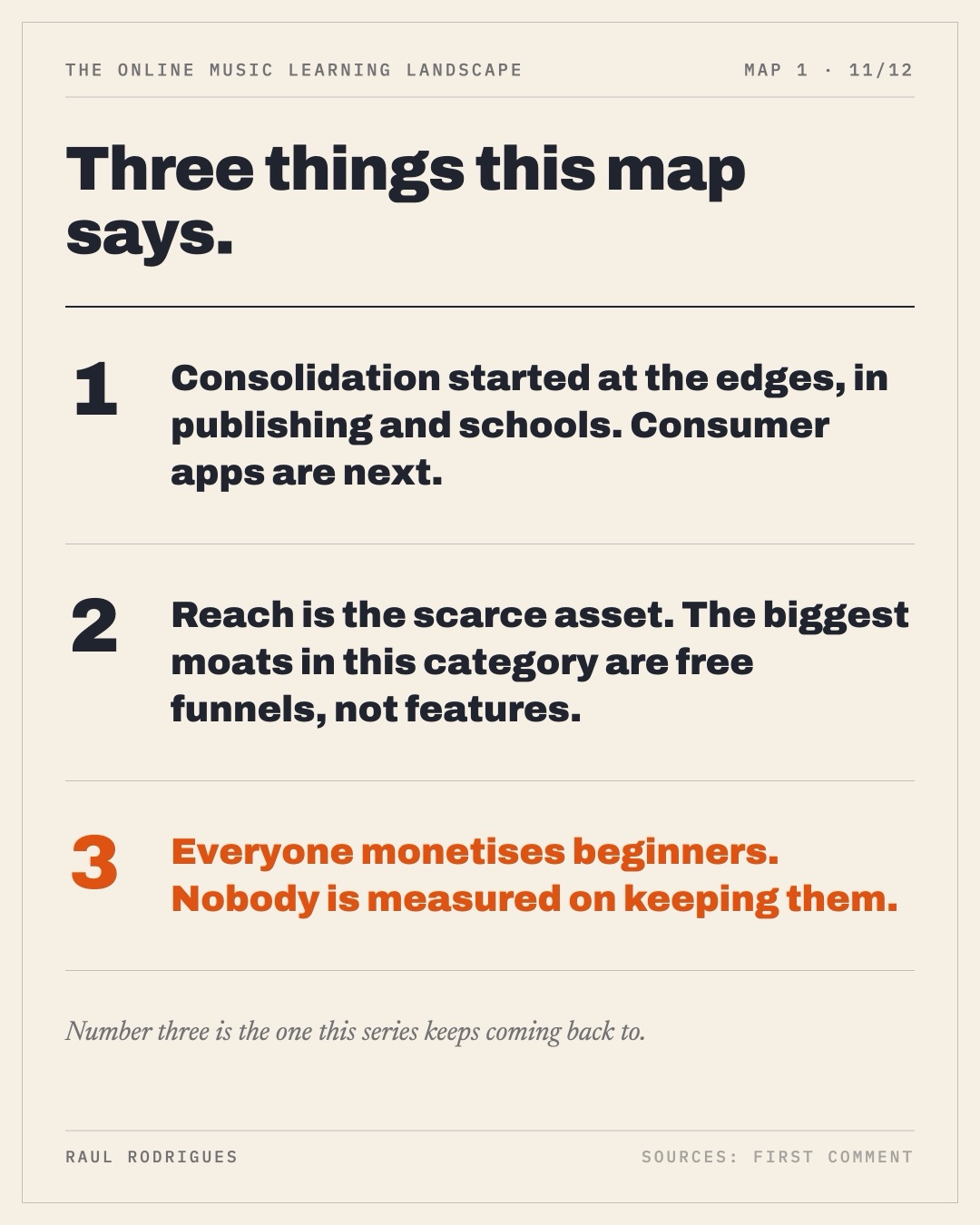
- Consolidation started at the edges, in publishing and schools. Consumer apps are next.
- Reach is the scarce asset. The biggest moats in this category are free funnels, not features.
- Everyone monetises beginners. Nobody is measured on keeping them.
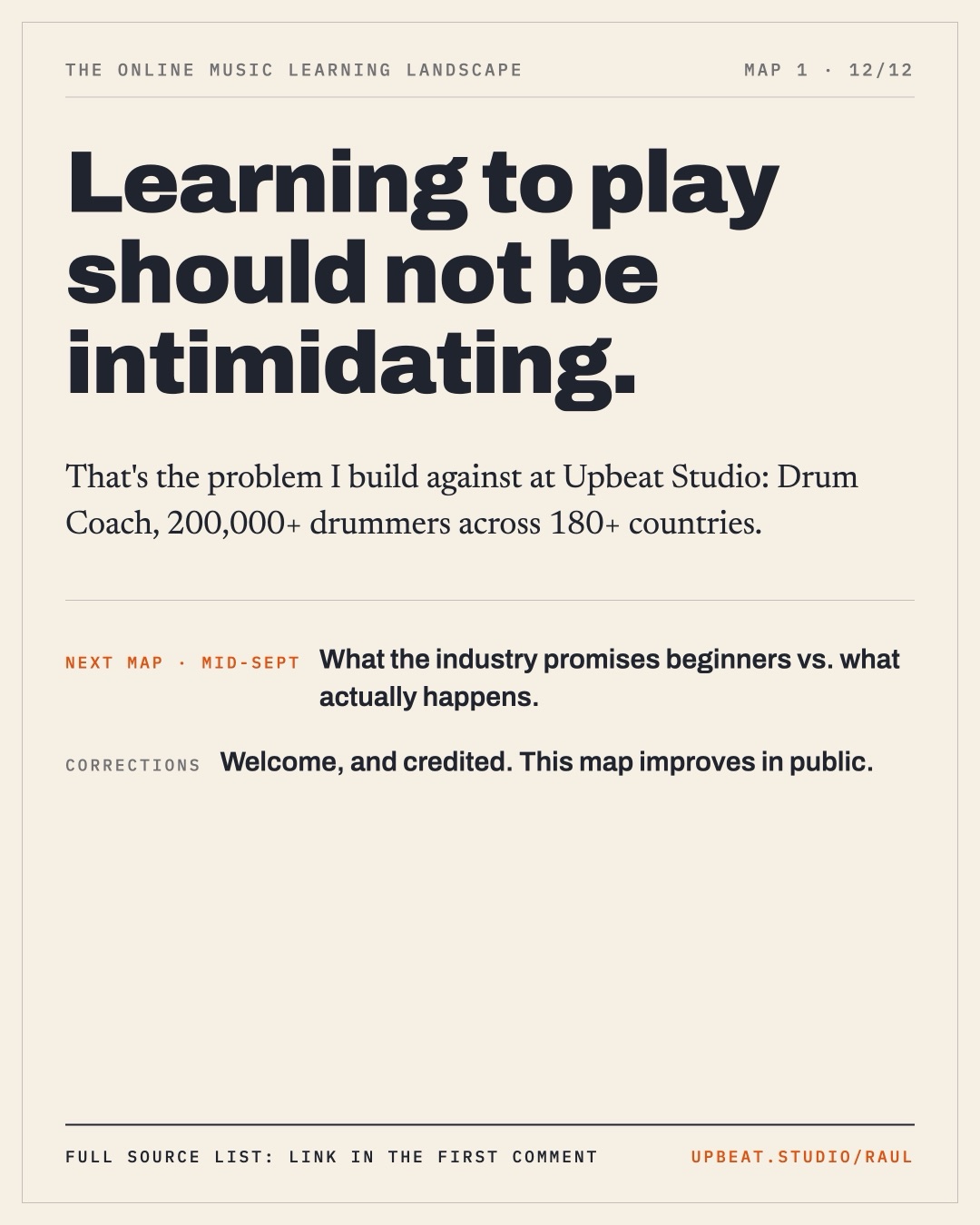
Learning to play should not be intimidating. That is the problem I build against at Upbeat Studio with Drum Coach. The third point above became the next map: The Promise Map, on what the industry promises beginners and what the data says happens.
Download the map: The Online Music Learning Landscape, PDF, 12 pages.
Sources, slide by slide
The dataset (slides 2 and 3)
The map draws on a dataset of more than 60 entities: platforms, manufacturers, ownership groups and closed companies. Every row carries a source URL, a year and a confidence label. On 26 August 2026 every app on the map was checked against its App Store seller of record through Apple's public lookup API.
Slide 4: where beginners go
The shares are labelled estimates, triangulated from three independent angles.
- YouGov survey of 3,000 US adults (2022), reported by Thomann: the instrument people would most like to play. Piano 47 percent, guitar 22 percent, drums 8 percent. thomannmusic.com
- Fender and YouGov "New Player Landscape" (2021, 10,000+ respondents): 16 million Americans started guitar in the prior two years. prnewswire.com
- App install brackets (Google Play, August 2026): Simply Piano 50 million+ installs against Simply Guitar 10 million+ from the same publisher. US retail data used as a floor check for drums.
Slide 5: ownership
- Muse Group owns Ultimate Guitar, MuseScore, Audacity, StaffPad and Hal Leonard. Hal Leonard deal closed December 2023: Music Business Worldwide. Francisco Partners exited June 2026: Scoring Notes.
- Musora Media: five brands built in house, buyout offers declined. Globe and Mail, 2025. PlayBass confirmed on musora.com (2026). The App Store record for Beatlii shows bundle id rocks.freedrum.app and seller Musora Media Inc, meaning Musora now publishes the renamed app of bankrupt Freedrum (checked 26 August 2026): apps.apple.com.
- Simply: three music apps under one brand, one billion dollar valuation in 2021: NoCamels.
- Growth Catalyst Partners rolled up TrueFire and JamPlay (2019 to 2020), ArtistWorks (2021) and Blayze (2025): Private Equity Wire and TrueFire.
Slide 6: the money
- Musora: "mid-eight-figure" revenue, profitable, 100,000+ paid subscribers. Globe and Mail, 2025.
- Yousician: EUR 53.0M revenue in 2025 with an operating profit of EUR 3.7M and 118 staff (2024: EUR 53.3M). Finnish statutory accounts via Finder.fi (2026).
- Simply: 100 million dollars of revenue in 2020: Calcalist. One billion dollar valuation a year later (NoCamels, above). Nothing newer is public.
- "Everyone else: undisclosed" was checked against registries and press through August 2026. US and Israeli private companies publish nothing. flowkey files annual statements in the German registry, but German law lets small companies file balance sheets without a revenue line: North Data (2026).
Slide 7: how the money is made
- Melodics for V-Drums (Roland, 2018): roland.com. Alesis bundles 30 days of Melodics: support.alesis.com. Korg bundles: korg.com (2019).
- flowkey and Yamaha (to March 2027): usa.yamaha.com. Tomplay and Yamaha US (2024): usa.yamaha.com.
- GuitarTuna: 180 million downloads, self-reported (2026): guitartuna.com/about.
- Musora: one membership across five brands (musora.com, 2026). MakeMusic Cloud, the school channel (2026): makemusic.com.
Slide 8: manufacturers
- Casio Music Space, in-house learning app (2022): prnewswire.com.
- Donner Play, in-house app (2026): apps.apple.com.
- Fender Play: about 110,000 paying subscribers before COVID; about 930,000 at the peak of the 2020 free promotion. Forbes, 2022.
- GEWA: no learning app found, module features only (gewadigitaldrums.com, 2026).
Slide 9: the graveyard
- TakeLessons (Microsoft): closed 15 November 2024: learn.microsoft.com.
- Soundtrap: Spotify sold it back to its founders (2023): Music Business Worldwide.
- Rocksmith+: the studio behind it closed December 2024; the service runs in maintenance mode: PlayStation LifeStyle.
- Finale: sunset August 2024 after 35 years: makemusic.com.
- Freedrum: bankrupt October 2024, its second insolvency: Øresund Startups. Its app lives on as Beatlii under Musora's account (slide 5).
Slide 10: the squeeze
- Duolingo parent scale: 137.8 million monthly active users and 12.5 million paid subscribers (Q1 2026 earnings, May 2026): Yahoo Finance. Music usage is not broken out; the figure is parent-company scale.
- Duolingo's FY2025 annual report states the Music and Math courses have not generated material revenue (SEC filing, 2026): sec.gov.
- The 249 dollar Loog and Duolingo piano (September 2024): Music Ally.
Slide 12
- Drum Coach: 200,000+ drummers across 180+ countries. upbeat.studio (2026).
Corrections log
- Before publication, 26 August 2026: a reader pointed out that Beatlii is the renamed app of bankrupt Freedrum. I checked it against Apple's public app record (bundle id rocks.freedrum.app, seller Musora Media Inc) and changed slide 5, which had said Musora had made zero acquisitions. Credited with thanks.
- 16 September 2026: the map moved from LinkedIn to this page with the full source list. No figures changed.
If you find a figure that is wrong, outdated or missing its context, message me on LinkedIn. Verified corrections are folded into the map and credited here.
About the author
I am Raul Rodrigues, a drummer, a former music-school founder and the founder of Upbeat Studio in Valencia, where we build Drum Coach and Drum Notes. I map the music learning industry because nobody else publishes it. Find me on LinkedIn.
YOU MIGHT ALSO LIKE

The Promise Map: What Music Learning Apps Promise Beginners, and What the Data Says Happens
Map 2 of the online music learning industry. Eight of twenty platforms name a time to your first song. Two in three people who learned an instrument no longer play. Nobody publishes what happens in between. By Raul Rodrigues.
How Atlanta Makes Drummers
Atlanta produces a remarkable number of working drummers. Not by accident: the city has an unusual concentration of institutions that teach rhythm to children and keep teaching it into adulthood.
The Five Pillars of Drumming: What Every Beginner Should Practice
Technique, coordination, styles, reading, and improvisation — the five pillars every beginner drummer should balance. A recap from our live session.