This page is the whole map on one screen: every symbol drum notation uses, where it lives on the staff, and what it sounds like, click any note to hear it. When you can name all seven voices at a glance, everything else about reading drums is just rhythm. Keep the near your kit for the first few weeks.
Skip straight to practicing: the free Drum Notation Trainer drills this until reading it is automatic, no signup and no drum kit needed.
The full key, with sound
Two rules organize everything. Position = drum: low drums sit low on the staff, high ones sit high. Shape = material: oval noteheads are drums (skin), × noteheads are cymbals (metal). Here is the whole map laid over a real kit, the same reference we use inside Drum Coach:
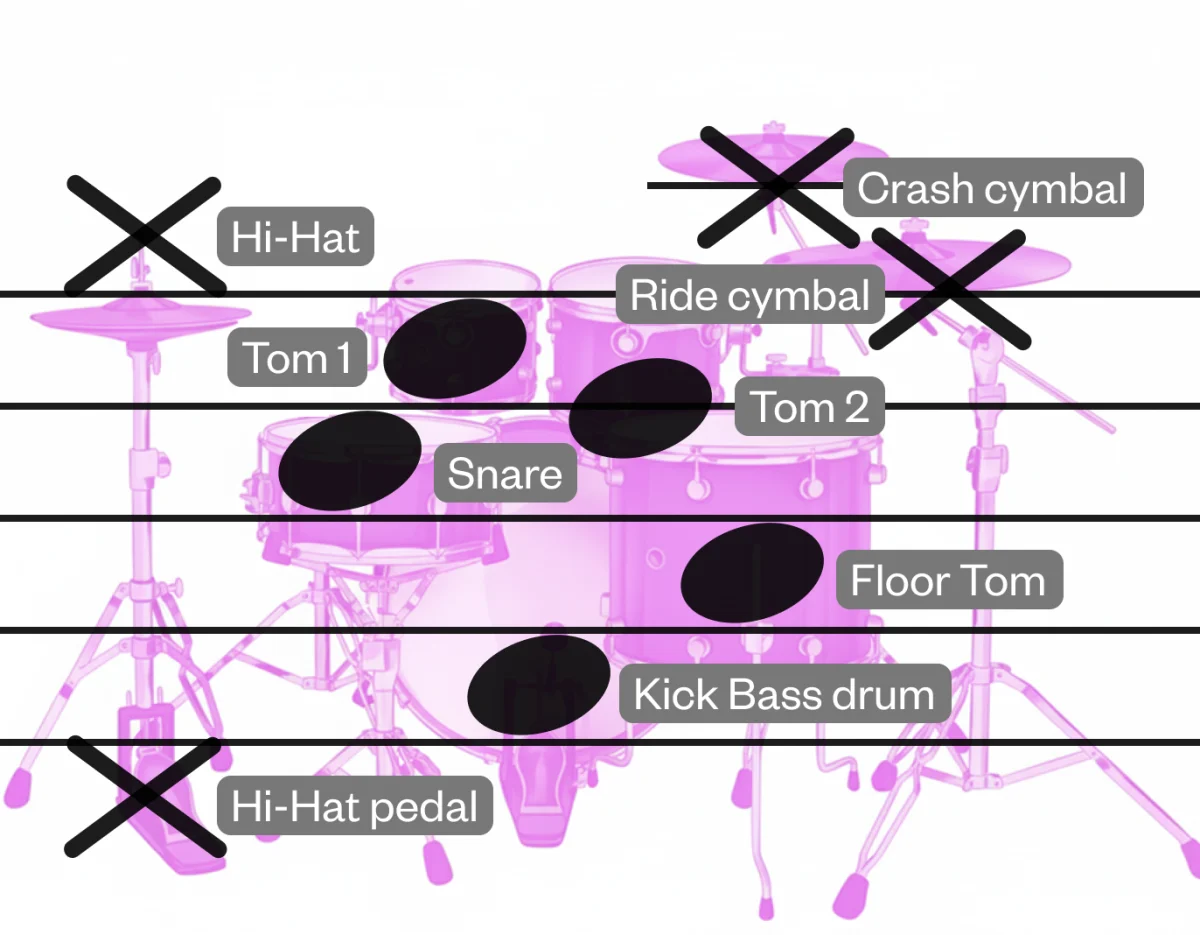
Now hear it. Click any note below:
Tap a drum to hear it and find it on the staff.
Left to right, top of the staff to the bottom: crash · hi-hat · ride · high tom · snare · floor tom · kick.
| Voice | What it does |
|---|---|
| Crash | Accents and arrivals: section starts, the landing after a fill. |
| Hi-hat | The timekeeper. Played with the stick; “×” means metal. |
| Ride | The hi-hat's big brother, same job, washier sound. |
| High tom | First stop of most fills. |
| Snare | The backbeat, beats 2 and 4 in most grooves. |
| Floor tom | The fill's last stop before the kick. |
| Kick | The anchor, beat 1 and the groove's low end. |
Rhythm at a glance
Stems and beams carry time. A bare stem is a quarter note (one beat). One beam joins 8th notes (two per beat, “1 & 2 &”). A double beam means 16th notes (four per beat, “1 e & a”). Rests mark silence with the same precision: the jagged squiggle is a beat of space, the flagged dot half a beat.
Bar 1: quarter notes. Bar 2: beamed 8th notes, same tempo, twice the grid.
The key in action
Here is the standard rock groove using the key: hi-hat ×s on the 8ths, snare in the middle on 2 and 4, kick in the bottom space on 1 and 3. If you can name every symbol in this bar, the key has done its job, the complete reading guide teaches you to read it fluently, and the trainer makes it automatic.
Prints as a clean, ink-friendly single page, tape it where you practice.