
Practice Drums Without a Drum Set: Why You Don't Need a Kit to Improve
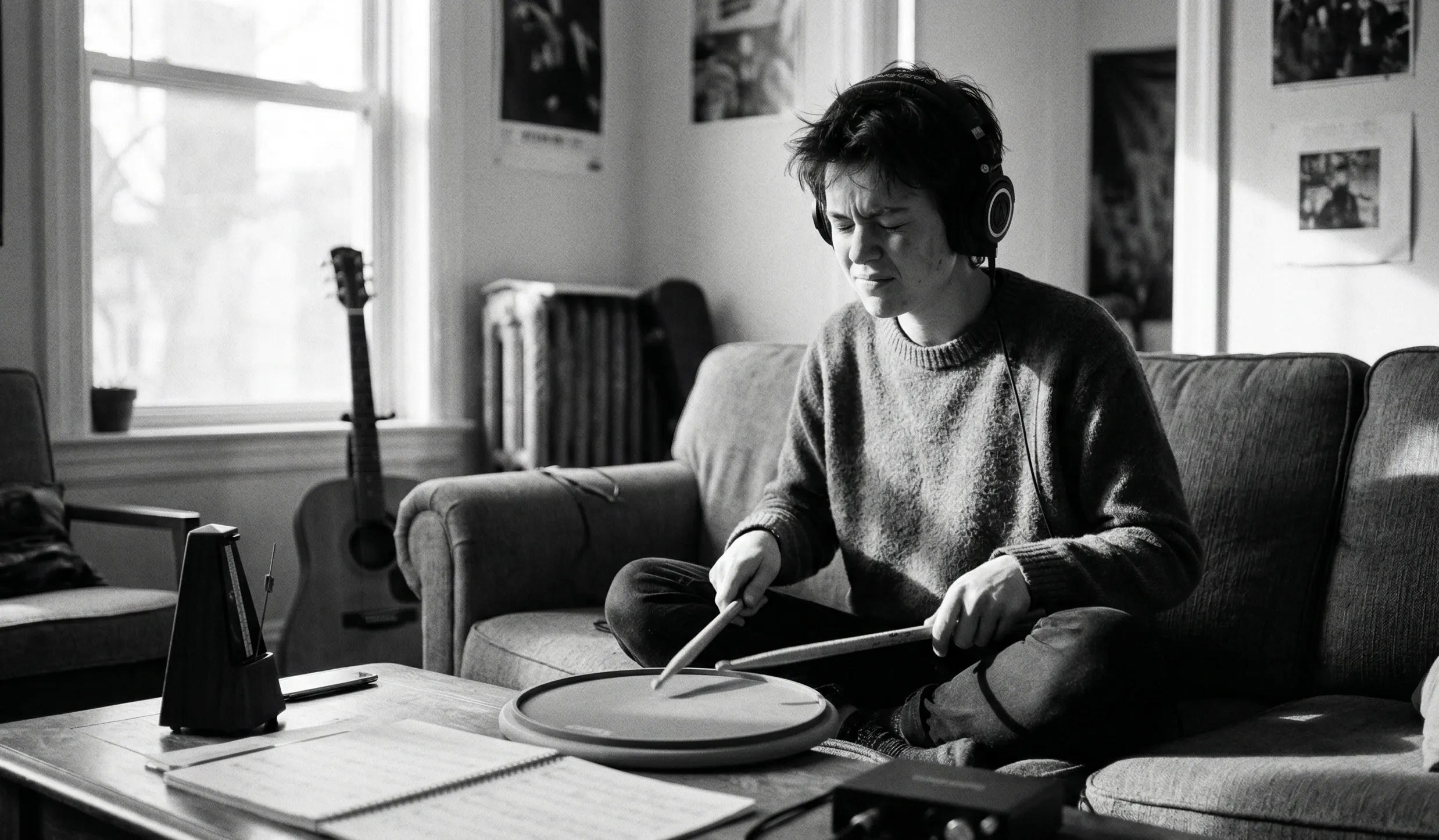
Some of the best drummers in history have said the same thing in different words: the music is not in the drums. It is in you.
Your coordination, your sense of time, your rhythmic ideas, your feel, all of it lives in your body and your brain. The drum set is an extension, a tool for expressing what is already there. Take the drums away and the musician remains.
This is not a consolation for people who cannot afford a kit. It is a genuine advantage. When you strip away the instrument, you strip away distraction. No cymbals to crash, no toms to fill, no volume to hide behind. What remains is pure: your hands, your timing, and the quality of your movement.
That is why professional drummers, touring musicians who have access to world-class kits, still spend serious time practicing away from the drums. Because they know: the foundation is built in the body, not on the instrument.
The practice pad: every drummer's most important tool
If you invest in one piece of equipment beyond sticks, make it a practice pad.
A practice pad is a small rubber surface mounted on a base that simulates the rebound of a real drumhead. It is portable, quiet, affordable, and brutally honest. Every flaw in your technique, uneven strokes, grip tension, inconsistent dynamics, becomes audible on a pad in ways that a full kit can mask with volume and resonance.
Why every drummer uses one: practice pads are not just for beginners warming up. Professional drummers carry them on tour. Session players use them backstage. Teachers use them in every lesson. The pad strips drumming down to its essence, your hands, your sticks, and the quality of each stroke.
And here is the key insight: you can practice anything on a pad. Not just rudiments and technique. Coordination patterns, groove stickings, dynamic phrasing, reading exercises, even full song structures mapped to hand patterns. The pad is a blank canvas, not a limited tool.
Pair it with a metronome and you have a complete practice station that fits in a backpack.
Your body is the instrument
You do not even need a pad to practice. Your body is a percussion instrument.
Think about what drumming actually requires: coordinated limb movements at specific times. You already do this constantly. Walking is a coordination exercise, legs alternating, arms swinging in opposition, core stabilizing, all without conscious thought. Driving requires feet on pedals, hands on the wheel, eyes scanning, brain processing, simultaneously. Cooking, texting while talking, carrying groceries while climbing stairs, your body coordinates complex multi-limb actions every day.
Drumming coordination is the same principle, applied to rhythm. And you can train it anywhere:
Tapping exercises. Sit in a chair and tap on your thighs. Use the same sticking patterns you would on a pad, singles, doubles, paradiddles, accents. Your thighs provide enough resistance to engage the same muscle groups. A table, a book, a couch cushion, all work as surfaces.
Foot independence. Tap your left foot on beats 1, 2, 3, 4 while your right foot plays different patterns, eighth notes, offbeats, syncopation. Add hand tapping on your thighs and you have four-limb coordination without a single piece of equipment.
Full beat simulation. Right hand taps eighth notes on your right thigh (hi-hat). Left hand taps beats 2 and 4 on your left thigh (snare). Right foot taps beats 1 and 3 on the floor (bass drum). You are now practicing the fundamental rock beat with nothing but your body.
The muscle memory is real. Your brain does not distinguish between tapping a pad and tapping your leg when it comes to building neural pathways for coordination. The physical feedback differs, but the motor learning transfers directly.
Mental rehearsal and active listening
Some of the most productive practice does not involve moving at all.
Visualization. Close your eyes. Picture yourself behind a kit. Visualize playing a groove, see your hands moving, feel the bass drum foot, hear the pattern in your head. Run through it slowly. Research in motor learning consistently shows that mental practice activates many of the same neural pathways as physical practice. It is not a replacement, but it is a powerful supplement.
Active listening. Put on a song and listen with intent. Where is the kick? Where is the snare? What is the hi-hat doing? Are there ghost notes? When do the fills happen? This analytical listening trains your ear and builds a mental map of drum parts. When you eventually sit behind a kit, learning that song becomes dramatically faster.
Reading practice. If you have access to drum notation, whether from Drum Notes or a method book, practice reading without playing. Follow along with your eyes, count the rhythms in your head, tap your foot to keep time. Reading builds vocabulary: every written pattern you work through becomes part of your musical language, available when you groove, fill, or improvise. You can do structured reading exercises in Drum Coach as well.
Practice tools that go anywhere
Your phone is a surprisingly effective practice station.
Metronome. Indispensable for off-kit practice. Work on subdivision training, no sticks needed. Set a tempo and count along: quarter notes, eighth notes, sixteenth notes, triplets. Clap on specific subdivisions. Try this: set the metronome to 60 BPM and count quarter notes out loud. Then set it to click only on beat 1 of every two bars. This trains your internal clock, arguably the most important skill any drummer can develop. To find out how well it is working, run the metronome challenge: the click goes silent for a few beats and you tap or clap back in on the beat it returns, scored in milliseconds.
Drum Coach. Use the app for structured practice sessions without a kit. Follow along with hand tapping or a practice pad, working through progressive challenges that build technique, timing, and reading skills.
Drum Notes. Write and read drum notation on any device. Use it to study rhythmic figures, build sight-reading fluency, or compose your own exercises.
When do you actually need the drums?
The drum set becomes essential for two things: extended technique and ensemble playing.
Extended technique means things that only work on the real instrument, cymbal dynamics, tom voicings, bass drum pedal feel, hi-hat foot control, the physical distance between surfaces, and the acoustic feedback that shapes your touch. These require the kit.
Ensemble playing, rehearsing with a band, playing along with recordings at volume, working on stage dynamics, also demands the full instrument.
But for building coordination, technique, timing, reading, and musical ideas? Half your practice time can happen away from the kit. Many professional drummers structure it exactly that way: pad and mental work during the week, kit time for application and ensemble preparation.
Make it a habit
The biggest advantage of off-kit practice is that it removes every barrier. No drive to a rehearsal space. No noise complaints. No setup time. Just your hands, a surface, and a few minutes of focused attention.
The drummers who improve fastest are the ones who practice consistently. Ten minutes of focused pad work every day outpaces an hour-long kit session once a week.
Start with a simple routine, even a 5-minute daily routine is enough to maintain momentum. Combine it with the warm-up exercises that every drummer should know. If you are just starting out, the beginner exercises guide gives you a clear path forward, and your first 7 days on drums is a day-by-day plan that needs no kit at all.
For the full picture, head back to The Complete Drum Practice Guide.
No kit? No excuses. The music is in you. The drums just make it louder.
Practice this with Drum Coach
Get a structured practice plan with AI feedback, built-in metronome, and progress tracking.


7-day free trial.
Learn more about Drum Coach