
Drum Warm-Up & Stretching: The Injury Prevention Guide Every Drummer Needs
Why I Wrote This Guide
I am Raul, CEO at Upbeat and a drummer for more than 20 years. I have tendinitis in both elbows. Lateral epicondylitis, the kind they call tennis elbow, in both arms, from drumming.
It did not happen overnight. It built up across years of playing without stretching, without warming up, without paying attention to the signals my body was sending. By the time the pain became constant, the damage was done. Now, before every practice session, I have to stretch carefully. After playing, it usually hurts, sometimes enough that I need to stretch again and put ice on both elbows. Some days I cannot play at all.
This guide exists because 68% of drummers report experiencing a playing-related musculoskeletal disorder at some point in their career, according to a 2022 study published in PMC. Drummers who received injury prevention education had roughly half the odds of reporting lifetime injuries. The science is clear: warming up works. Let me show you exactly what to do.
What Happens Inside Your Body When You Drum
Drumming is one of the most physically demanding activities in music. Professional drummers burn 500 to 600 kcal per hour with average heart rates at 79% of their maximum, comparable to professional soccer.
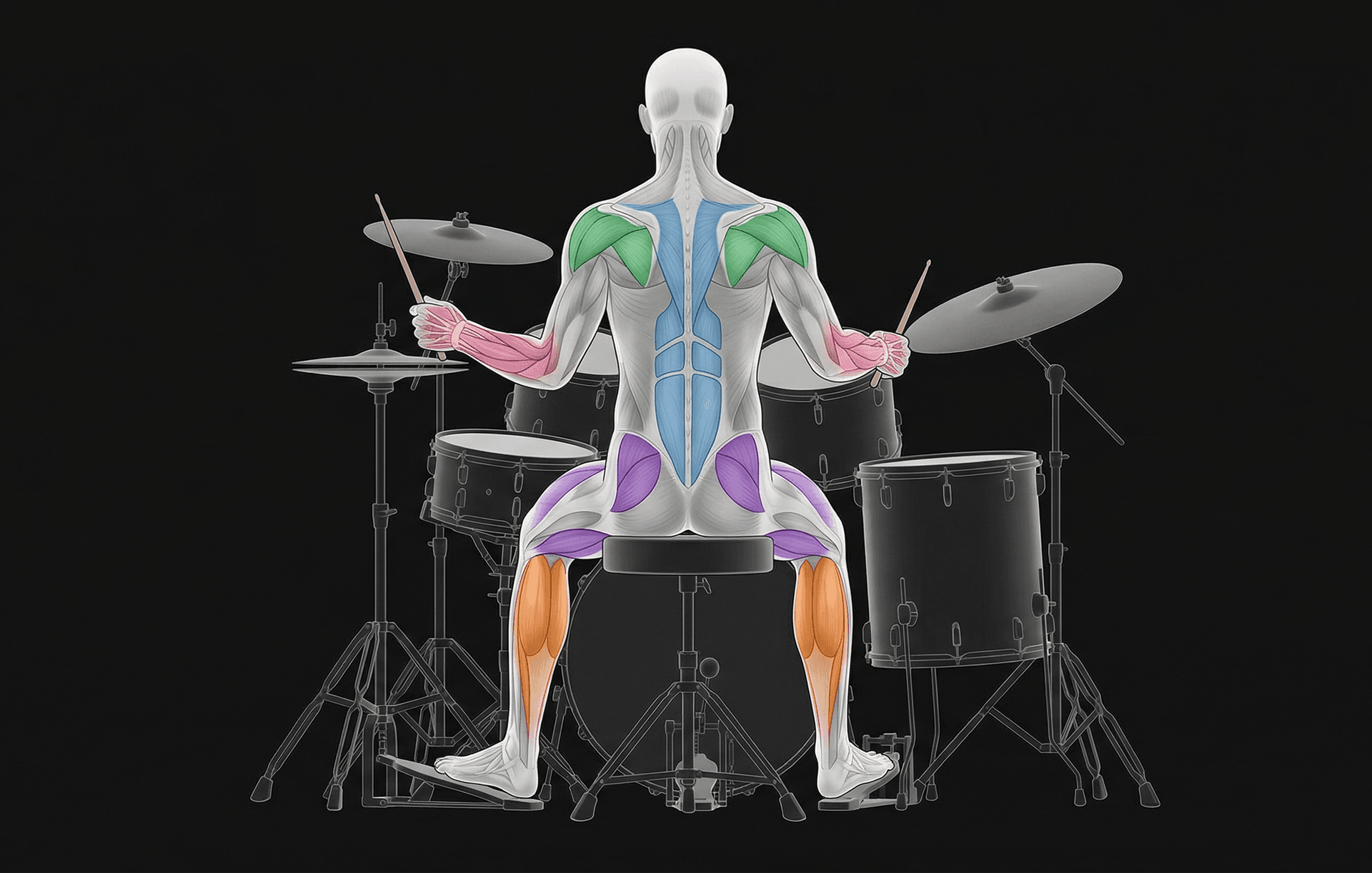
Upper Body
Triceps generate the downward stroke. Biceps act as the brake. Deltoids move your arms between drums and cymbals. The rotator cuff stabilizes every single arm movement.
Forearms & Wrists
Where most injuries happen. Extensors control rebound, flexors grip the stick. Pronators and supinators rotate your forearm for technique changes and rimshots.
Core & Back
Erector spinae hold you upright for the entire session. Abdominals and obliques stabilize your trunk during powerful strokes and rotational movements.
Lower Body
Tibialis anterior powers heel-down technique. Calves and the Achilles tendon transmit force to both pedals. Hip flexors drive heel-up bass drum technique.
Why Cold Muscles Are Dangerous
Reduced Blood Flow
Cold muscles receive less oxygen and fewer nutrients. Tendons, which already have considerably less blood supply than muscles, are especially vulnerable.
Stiff Joints
Synovial fluid, the lubricant inside your joints, is more viscous when cold. More friction with every movement means more wear.
Reduced Elasticity
Warm muscles, tendons, and ligaments are up to 20% more elastic than cold ones. A cold tendon absorbs impact poorly. A warm tendon absorbs it efficiently.
The Most Common Drumming Injuries
Understanding what can go wrong helps you understand why each stretch matters.
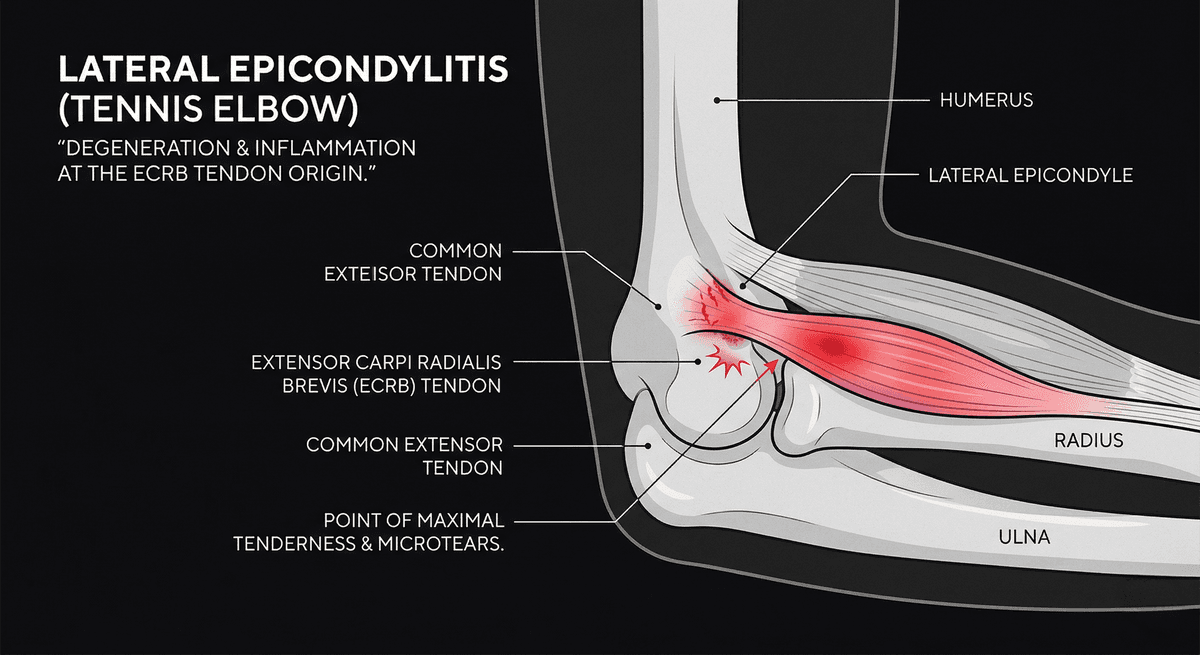 Lateral epicondylitis: the most common overuse injury in drummers
Lateral Epicondylitis (Tennis Elbow)
Inflammation and degeneration of the extensor carpi radialis brevis tendon at the outside of the elbow.
Excessive gripping, repetitive wrist extension, and high-volume playing without breaks.
Gnawing pain on the outside of the elbow that worsens when gripping, turning a doorknob, or shaking hands. Can take close to a full year to resolve.
Carpal Tunnel Syndrome
Compression of the median nerve within the carpal tunnel of the wrist.
Repetitive wrist flexion combined with sustained grip pressure. Swelling narrows the carpal tunnel.
Burning, numbness, or tingling in the thumb, index, and middle fingers. Grip strength weakens.
Tendinitis / Tendinosis
Acute inflammation (tendinitis) or chronic degeneration (tendinosis) of tendons in the wrist, forearm, or shoulder.
Overuse without adequate recovery. Tendons have poor blood supply and heal much slower than muscles.
Localized pain during and after playing. The most common and devastating injury in drummers.
De Quervain's Tenosynovitis
Inflammation of tendons on the thumb side of the wrist.
Especially common with traditional grip, where the thumb's CMC joint is repeatedly stressed.
Constant aching pain on the thumb side of the wrist, worsening with activity.
Shoulder Impingement
The supraspinatus tendon gets pinched between the bones of the shoulder during overhead movements.
Crash cymbals positioned too high, repetitive reaching, poor shoulder posture.
Pain when raising the arm, especially during overhead cymbal hits. Setup matters more than most players realize.
Lower Back Pain
Strain and fatigue of the erector spinae and supporting muscles from prolonged seated posture.
Weak core muscles, poor spinal alignment, sessions beyond your endurance.
Dull ache in the lower back that worsens during long sessions. Strengthening the core helps.
The Pre-Practice Stretching Routine
Based on the protocol by Dr. Luga Podesta, a sports medicine physician who specializes in drummer injuries. “Warm up to drum. Do not drum to warm up.”
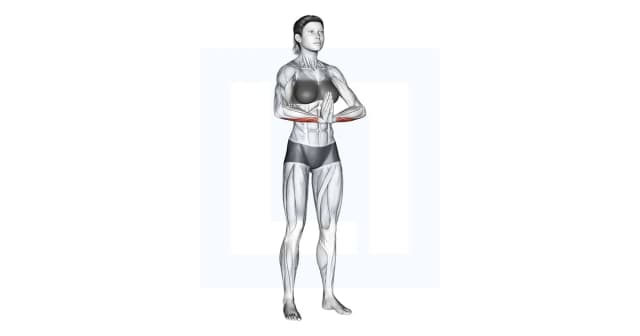
Wrist Flexor Stretch
Forearm flexors / grip muscles- Extend one arm straight in front of you, palm facing up, elbow straight
- Use your opposite hand to gently pull your fingertips and wrist backward toward your body
- You should feel the stretch along the underside of your forearm
- Hold 10 to 15 seconds per side
Quick Reference
The complete sequence at a glance. On short days, prioritize stretches marked Priority. They cover the areas most prone to injury (forearms, shoulders). That takes about 3 minutes.
Total time: 7 to 9 minutes.
After You Play: Recovery
Post-Session Stretching
Repeat the same routine after you play. Your muscles and tendons are warm, making post-session stretching the most effective time to improve flexibility and reduce soreness.
Ice Protocol
If any area feels inflamed, apply ice with a thin barrier for 10 to 20 minutes. Repeat every hour or two. Ice is most effective within 8 hours after activity.
The 10% Rule
Increase your practice volume and intensity by no more than 10% per week. Gradual progression gives tendons and ligaments time to adapt. This single rule prevents the majority of overuse injuries.
When to See a Doctor
Early intervention changes outcomes dramatically. A tendon caught at the inflammation stage can heal in weeks. A tendon that has progressed to degeneration can take months or longer.
Get the warm-up routine card
Download a printable warm-up card with the tension scan checklist, 6 priority stretches, and stick exercises. Stick it next to your kit and never skip a warm-up again.
Most drummers think of stretching as optional. Something that slows you down before the real work starts. I thought that too, for about 15 years.
Now I stretch because I have to. Because without it, I cannot play at all. I would trade every fast fill I ever played for healthy elbows.
You have the chance to build this habit before the damage is done. Seven to nine minutes before your session. The same routine after. That is all it takes to protect the thing that makes drumming possible: your body.
For a complete framework on how warm-ups fit into your daily practice, see The Complete Drum Practice Guide. If you are just getting started, the Beginner Exercises guide walks you through your first week with proper technique from day one.
Take care of yourself first. The groove will follow.
Practice this with Drum Coach
Get a structured practice plan with AI feedback, built-in metronome, and progress tracking.


7-day free trial.
Learn more about Drum Coach