
How to Play Djembe for Beginners: Master Bass, Tone & Slap
Learn how to play djembe for beginners. Master the 3 basic sounds (Bass, Tone, Slap), perfect your posture, and play your first traditional rhythms.
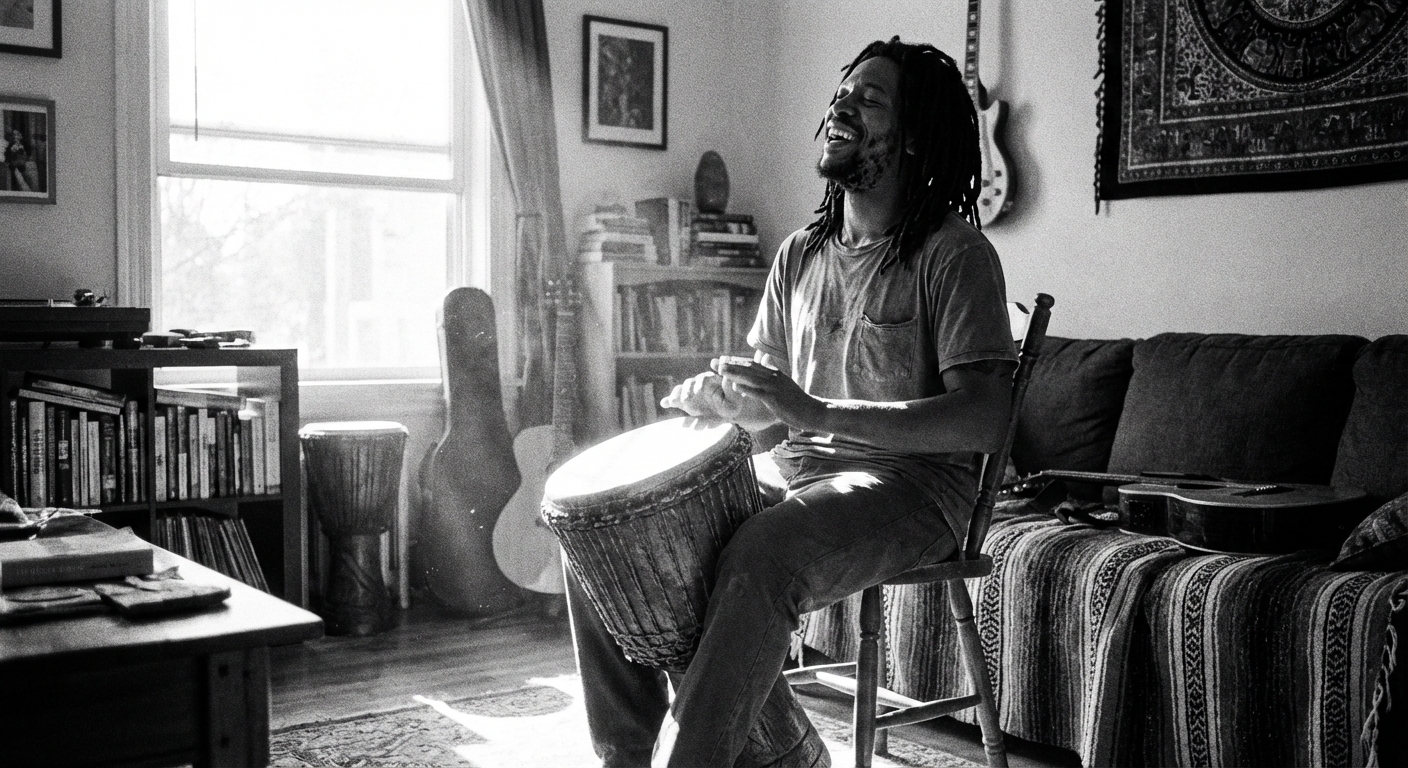
Most beginners quit the djembe for one reason: physical pain. They hit the drum hard, their hands bruise, their back aches, and the sound is flat and cardboard-like.
If you are "hitting" the drum, you are already working too hard.
The djembe is not a percussion instrument you strike; it is a linguistic instrument you speak through. In West African tradition, the drum doesn't just make noise; it talks. The masters do not use muscle to force sound out of the goat skin; they use gravity and physics to let the sound escape.
In this guide, we are going to fix your mechanics. We will move away from "banging on a drum" to the "Speak with Your Hands" method, ensuring you can play for hours without pain and with a tone that carries.
1. Respect the Lineage: Context Before Contact
Before you lay a hand on the skin, understand what you are holding. The djembe is not a campfire toy. It is a sacred vessel of the Manding people, originating from the Mali and Guinea empires. Historically, the Djembefola (djembe player) was the glue of the community, accompanying everything from weddings to farming work.
Your drum is an assembly of three organic parts:
- The Shell: Carved from a single piece of hardwood (like Lenke or Iroko).
- The Skin: Traditionally goat spine, aligned down the center for balance.
- The Mali Weave: The complex rope system used to tune the drum.
Treating the instrument with respect changes how you play it. It demands focus, not frantic hitting. When you approach the drum with the mindset of a student of tradition, your sound immediately improves because you stop trying to dominate the instrument and start listening to it.
2. Ergonomics: Stopping Back Pain Forever
Most beginners sit with the drum flat on the floor or squeezed tightly between their knees. This chokes the sound and ruins your spine. The sound comes out of the bottom of the drum; if you block the bottom, you kill the bass.
We use a setup called The Tripod of Power to ensure resonance and save your lower back.
The Angle
Sit on a stool or chair. Tilt the djembe away from you. The base of the drum should rest on the floor, but the top should be tilted forward so the bottom opening acts like a "Bass Port," firing the sound toward your audience. This tilt is crucial—without it, the air cannot escape, and your bass notes will sound like thuds.
The Grip
Do not use your hands to hold the drum. Your legs must do the work. Your calves or ankles (depending on the drum size) gently lock the drum in place. Your hands must be completely free to move. If you are using your left hand to steady the drum, you are playing with 50% capacity.
The Straight Spine
This is a core Upbeat Studio principle, similar to what we teach in essential drumming techniques. If you hunch over the drum, you compress your diaphragm and limit your arm movement. Sit with a straight spine, shoulders dropped away from your ears. If you feel tension in your neck, you are trying too hard.
3. Mechanics: The "Heavy Arm" for Effortless Volume
The biggest mistake beginners make is playing from the wrist, like a T-Rex. This causes tension and produces a thin, "slappy" sound.
To get a deep, resonant tone, you must use the "Heavy Arm" principle.
Imagine your arm is a heavy rope. Your shoulder is the anchor. When you play, you are not pushing your hand into the drum; you are simply lifting your forearm and letting gravity drop it. The weight of your arm creates the volume, not the muscle in your wrist.
- Relaxation is volume. Tension absorbs sound. The looser your arm, the louder and clearer the drum will sing.
- The Rebound: Just like a basketball, your hand must bounce off the skin immediately. If you leave your hand on the skin, you muffle the tone. Think of the drumhead as a hot stove—touch it and pull away instantly.
4. The Language: Gun, Go, Pa
In the djembe tradition, we don't use standard musical notation (Quarter notes, Eighth notes) as much as we use Phonetics. The drum speaks a language. If you can say the rhythm, you can play it. If you can't say it, your hands will never understand it. For those interested in how this compares to Western notation, you can check our guide on how to read drum sheet music.
We map the three sounds to specific syllables.
The Bass (Gun / Dun)
This is the heartbeat of the drum.
- Phonetics: "Gun" (Right Hand) / "Dun" (Left Hand).
- Hand Shape: Keep your fingers together and your hand flat.
- Zone: Strike the absolute center of the drum.
- Physics: Let the full weight of your hand drop. The entire palm and fingers should make contact, then bounce off immediately to let the bass boom.
The Tone (Go / Do)
This is the "tenor" voice, the melody of the drum.
- Phonetics: "Go" (Right Hand) / "Do" (Left Hand).
- Hand Shape: Keep fingers completely together, straight but relaxed. Thumb is tucked out of the way.
- Zone: The top third of your fingers strike the rim (edge) of the drum. The fleshy pads of your fingers do the work.
- Sound: It should sound round, woody, and hollow. No metallic ring.
The Slap (Pa / Ta)
This is the "crackle," the high-pitched accent. It is the hardest sound to master.
- Phonetics: "Pa" (Right Hand) / "Ta" (Left Hand).
- Hand Shape: Fingers are slightly open and relaxed.
- Zone: Similar position to the Tone, but the mechanics differ.
- The "Wet Towel" Physics: Imagine snapping a wet towel. You don't push the towel; you whip it. For the slap, your hand hits the edge, and your relaxed fingertips whip forward onto the skin and bounce back instantly.
- Differentiation: The main difference between a Tone and a Slap is that the Tone uses the meat of the finger (solid impact), while the Slap uses the velocity of the fingertips (whipping impact).
5. Tuning Basics: The Mali Weave
A djembe that is out of tune will hurt your hands and sound dead. Unlike a drum kit where you use a key, djembe tuning is done by weaving ropes.
The system is called the Mali Weave. It works by creating tension diamonds.
- Find the Slack: Locate the excess vertical rope.
- The Over-Under: Take the tuning rope and pass it under two vertical ropes (moving right to left).
- The Twist: Loop it back over the second rope and tuck it under to create a knot.
- The Pull: Pull the rope down hard. This twists the vertical ropes, shortening them and pulling the skin tighter.
Warning: Djembe skins are organic. If you tune it too high in cold weather and then take it into the sun, the skin can snap. Always de-tune slightly if traveling between extreme temperatures.
6. First Rhythms: From Words to Sentences
Now that you know the words (Gun, Go, Pa), let's speak a sentence. These patterns are the foundation of ensemble playing.
Exercise 1: The Signal (The Appel)
Every djembe arrangement starts with a signal. This tells the dancers and other drummers "We are starting now."
- Phrase: Gun Pa Gun-Gun (Flam)
- Sticking: Right - Right - Left/Right (Unison)
- This is a universal "Ready, Set, Go."
Exercise 2: The "Feuille" Accompaniment
This is a standard 4/4 rhythm used to support a soloist.
- Vocalization: Gun - Ta - Gun - Pa
- Sticking: R - L - R - L
- Focus: Keep the bass (Gun) deep and the slaps (Ta/Pa) crisp. Make sure they sound like two different instruments.
Exercise 3: The "Kuku" Bass Line
Kuku is a popular rhythm for fishing celebrations. The bass line is simple but requires steady timing.
- Vocalization: Gun Gun - Do - Gun Gun - Do
- Focus: Separate your hands. Don't let the "Do" (Tone) drift into the center of the drum. Precision is better than speed.
Note: You can find these full scores and play along with backing tracks in the Drum Notes app. It’s incredibly helpful to see the "Gun, Go, Pa" written out visually while you listen.
7. A Practice Routine that Works
You don't need to practice for hours. You need to practice with focus. Here is a 15-minute protocol used by professionals to build calluses and timing without injury.
- Minutes 0-5: Sound Check. Play only Bass (Gun) for 1 minute. Only Tone (Go) for 1 minute. Only Slap (Pa) for 1 minute. Focus entirely on the sound quality. If your hand hurts, stop and relax.
- Minutes 5-10: The "Say it, Play it" Loop. Pick a simple phrase (like Exercise 2). Sing it out loud: "Gun Ta Gun Pa." Then play it. Sync your voice with your hands.
- Minutes 10-15: Endurance. Set a timer (I use the simple timer in Drum Coach). Play a steady beat at a comfortable tempo without stopping. This builds the "stamina muscles" in your forearms.
Conclusion
Learning djembe is a journey of patience. Your hands will feel clumsy at first, and your slaps might sound like tones. That is normal. Remember the "Heavy Arm"—let gravity help you.
Don't just hit the skin. Speak the language. When you can close your eyes and hear the difference between your Gun, your Go, and your Pa, you are no longer just a beginner; you are a musician.
Frequently Asked Questions (FAQ)
What are the three basic sounds of the djembe?
The three sounds are Bass (Gun/Dun), which is the low boom played in the center; Tone (Go/Do), the round, woody sound played on the rim with closed fingers; and Slap (Pa/Ta), the high-pitched crack played on the rim with relaxed, open fingers.
How to tell the difference between a djembe tone and slap?
A Tone should sound hollow and steady, created by the "meat" of the fingers hitting the rim. A Slap sounds like a crack or a gunshot, created by the fingertips whipping onto the skin. If your Slap sounds dull, your fingers are likely too stiff. Relax them to get the "whip" effect.
What is the correct posture for playing djembe sitting down?
Sit with a straight spine on a stool. Tilt the drum away from you so the bottom opening is clear (The Tripod of Power). Hold the drum steady with your legs or ankles, not your hands. Never hunch over the drum, as this restricts your movement and causes back pain.
What do Gun, Go, Pa, and Ta mean in djembe drumming?
These are phonetic vocalizations used to teach rhythm orally.
- Gun/Dun: Right/Left Bass.
- Go/Do: Right/Left Tone.
- Pa/Ta: Right/Left Slap. Using these syllables allows you to "sing" the rhythm, which helps memorize complex patterns faster.
How to tune a rope-tuned djembe for beginners?
Tuning involves the "Mali Weave" system. You tune the drum by creating "diamonds" in the vertical ropes. You take the excess horizontal rope, pass it under two vertical ropes and back over one, then pull tight to create a twist or knot. This shortens the vertical rope and pulls the skin tighter. Warning: Beginners should be careful not to overtune, as djembe skins can snap under extreme tension.
YOU MIGHT ALSO LIKE
How to Read Drum Sheet Music: The Ultimate Guide to Rhythm Literacy
Unlock the language of rhythm! Learn how to read drum sheet music with our step-by-step guide. Master the staff, symbols, and counting systems today.
Marching Drumline Instruments: The Anatomy of a Modern Battery
Explore the anatomy of a modern marching drumline. From high-tension snares to the front ensemble, learn the physics and instruments of the battery.
Drum Rudiments for Beginners: 5 Essential Patterns to Master
Unlock speed, control, and musicality with this guide to 5 essential drum rudiments for beginners. Master singles, doubles, and paradiddles today.